Key takeaways
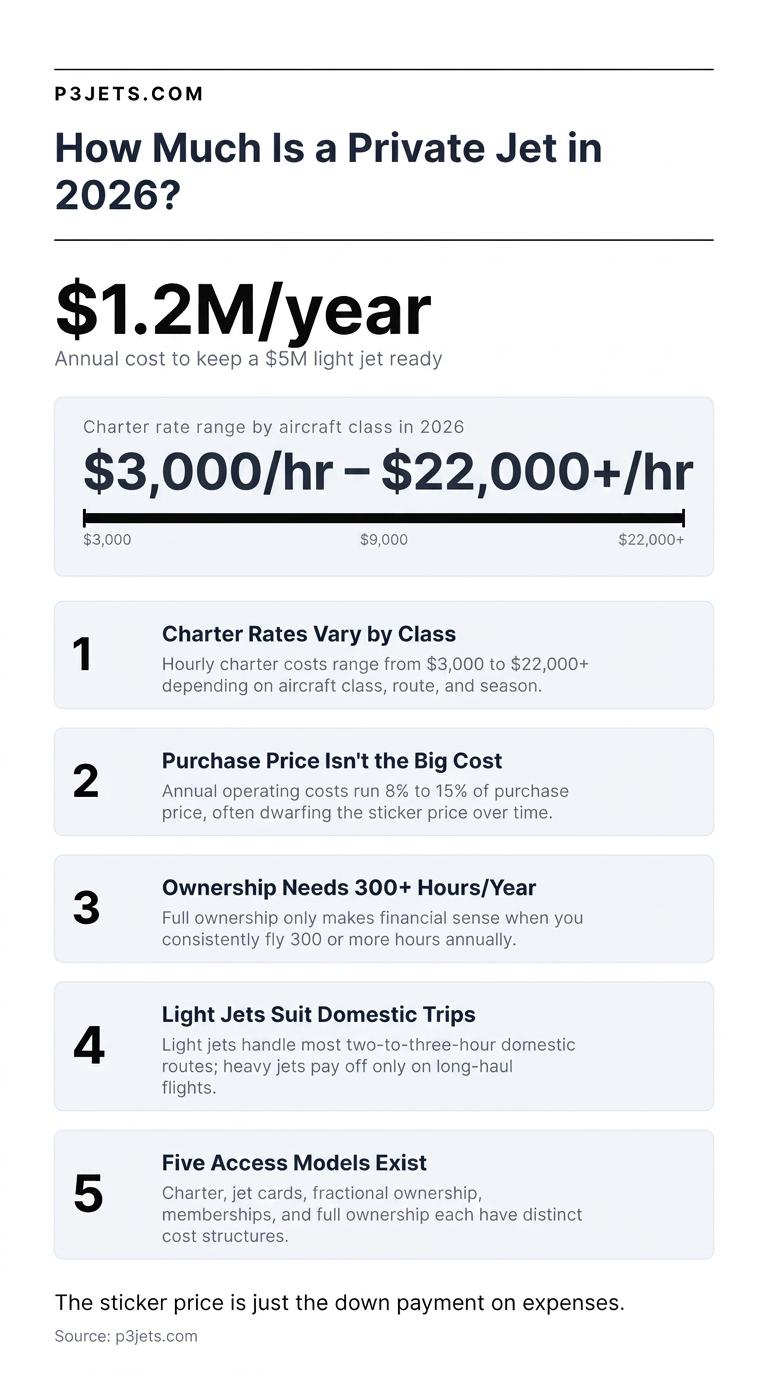
- A private jet charter in 2026 typically ranges from about $3,000 to $22,000 or more per flight hour depending on aircraft class, route and seasonal demand.
- Buying a private jet outright is rarely the most cost-effective path to flying privately, even for frequent flyers logging fewer than 200 hours per year.
- Chartering, jet cards, fractional ownership and full ownership each carry fundamentally different cost structures.
- Light jets suit most domestic trips of two to three hours, while heavy jets make financial sense on transcontinental or international routes.
- Matching the access model to your actual flying pattern usually saves more than chasing the lowest advertised rate.
Most people who search "how much is a private jet" expect a single number. That expectation leads to bad decisions. The sticker price is almost never the number that matters most. A $5 million light jet can cost $1.2 million per year to park, insure, crew and maintain. A $12,000-per-hour heavy jet charter can be cheaper per person than first class when eight people travel together.
The better question is: how much does it cost to fly privately the way I actually need to fly? In 2026, with charter pricing shifting because of fleet availability and fuel costs, this guide breaks down real private jet charter rates alongside purchase prices, hourly operating costs and the access models between renting and owning.
How much does it cost to charter a private jet in 2026?
Private jet charter rates typically run from about $3,000 per hour for a turboprop to $22,000 or more per hour for an ultra-long-range jet. The final price depends on aircraft class, route, travel date and positioning. Federal Excise Tax, segment fees and repositioning can sit outside an advertised hourly rate.
The paradox of private aviation pricing is that more choice can make comparison harder. Jet cards, fractional shares, on-demand charter, empty legs and membership programs all quote costs differently. Some bundle fuel and crew, while others add positioning fees that materially change the final invoice.
According to the National Business Aviation Association, business aviation includes many aircraft categories. For a useful price comparison, most charter missions fit into five broad tiers.
| Aircraft class | Typical hourly charter rate (2026) | Passenger capacity | Typical range |
|---|---|---|---|
| Turboprop | $3,000 to $4,500 | 4 to 8 | 800 to 1,200 nm |
| Light jet | $4,500 to $6,500 | 4 to 7 | 1,200 to 2,000 nm |
| Midsize jet | $7,000 to $9,500 | 7 to 9 | 2,000 to 3,000 nm |
| Super midsize jet | $9,500 to $12,000 | 8 to 10 | 3,000 to 4,000 nm |
| Heavy jet | $12,000 to $16,000 | 10 to 16 | 4,000 to 6,000 nm |
| Ultra-long-range jet | $16,000 to $22,000+ | 12 to 19 | 6,000 to 8,000 nm |
Those ranges do not necessarily include the 7.5 percent Federal Excise Tax on qualifying domestic transportation, passenger segment fees or repositioning. The actual invoice depends on origin, destination, date and how far the aircraft must fly empty to reach you. The cost per hour by aircraft class compares models such as the Citation CJ3, Challenger 350 and Gulfstream G650 individually.
How much does it cost to own a private jet?
A private jet can cost about $3 million for a pre-owned light jet and more than $75 million for a new ultra-long-range aircraft. Purchase price is only the opening cost. Crew, hangar, insurance, maintenance, fuel and management can add roughly $445,000 to $1.87 million per year for the examples below.
A pre-owned light jet might sell for $3 million to $5 million, while annual operating costs can run 8 to 15 percent of purchase price. A $4 million light jet can therefore cost roughly $320,000 to $600,000 annually before considering acquisition financing or depreciation.
Utilization changes the economics. At 200 hours, a light jet's effective hourly cost may land near $4,500. At only 50 hours, the same fixed expense can push the effective cost beyond $15,000 per hour, which is more than many heavy jet charters.
| Ownership cost category | Light jet annual estimate | Heavy jet annual estimate |
|---|---|---|
| Crew, two pilots | $180,000 to $300,000 | $350,000 to $500,000 |
| Hangar | $30,000 to $80,000 | $60,000 to $150,000 |
| Insurance | $25,000 to $50,000 | $50,000 to $120,000 |
| Maintenance reserve | $60,000 to $150,000 | $200,000 to $400,000 |
| Fuel at 200 hours | $120,000 to $200,000 | $350,000 to $600,000 |
| Management fee | $30,000 to $60,000 | $50,000 to $100,000 |
| Total annual estimate | $445,000 to $840,000 | $1,060,000 to $1,870,000 |
Full ownership generally enters the financial conversation when flying is consistently near 300 hours per year. Below that level, charter, jet cards or fractional shares often fit the mission more efficiently. The charter, jet card and fractional ownership comparison shows where each model can make sense.
Which private aviation model gives you the best value?
The best-value model is the one aligned with your annual hours, routes, passenger count and need for guaranteed availability. On-demand charter offers the lowest commitment. Jet cards trade a deposit for consistency, fractional shares add asset exposure, and full ownership adds maximum control along with the largest fixed-cost burden.
| Access model | Best suited to | Upfront commitment | Primary cost consideration |
|---|---|---|---|
| On-demand charter | Occasional and varied missions | None beyond each trip | Market pricing and repositioning |
| Jet card | Frequent flyers wanting predictable terms | Prepaid balance | Fixed rates, service area and peak days |
| Fractional ownership | High annual use with consistency needs | Share purchase plus monthly fees | Capital, occupied hours and resale value |
| Full ownership | Very high use and operational control | Aircraft purchase | Fixed costs, depreciation and utilization |
| Empty-leg charter | Flexible one-way travelers | Trip payment | Limited schedule and route control |
The cheapest option on paper is not always the one that saves money in practice. Availability guarantees, cancellation terms, aircraft substitutions, daily minimums and positioning can outweigh a small hourly-rate difference. Compare the complete trip cost and contract terms rather than one headline number.
What the price really depends on
Private jet pricing depends on what you are buying, how often you fly, the routes you use and how many people travel. For many flyers in 2026, charter remains the most accessible entry point, with light jets near $4,500 to $6,500 per hour and midsize aircraft near $7,000 to $9,500.
Know your route, aircraft class and season before evaluating a quote. The comparison of charter, jet cards and fractional ownership can help you match the model to your flying pattern. The real cost is not only the invoice. It is also the value of the time you get back.
Sources and methodology
Pricing ranges reflect P3 Jets quote and booking records over a rolling twelve months. Regulatory and travel requirements are drawn from the primary sources below.