Key takeaways
- The Bombardier Challenger 350 is a refined Challenger 300, not a new design. Both share the same flat-floor cabin, about 6 feet 1 inch tall and 7 feet 2 inches wide.
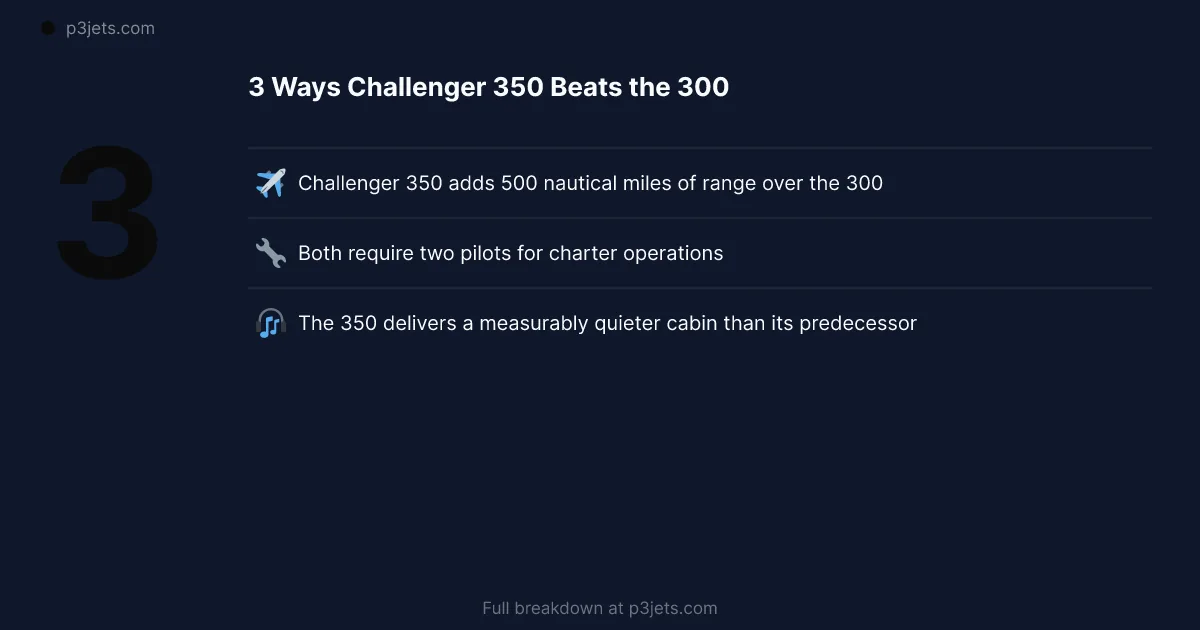
- The 350 adds more powerful Honeywell HTF7350 engines, canted winglets and Collins Pro Line 21 Advanced avionics, with published range of about 3,200 nautical miles versus about 3,100 for the 300.
- The real-world gap shows up as payload at range: the 350 carries a fuller cabin farther on long westbound legs and hot or high departures.
- Both aircraft require two pilots, and both typically charter in the super midsize range of about $7,500 to $9,800 per flight hour before tax and fees, with the 350 usually at the higher end.
- For coast-to-coast trips and most domestic flying, either aircraft works; pick the 350 when the mission pushes range, payload or runway limits.
Bombardier didn't replace the Challenger 300 when it introduced the Challenger 350 in 2014. It refined it. The two aircraft share a fuselage, a type rating and a remarkably similar passenger experience. The differences are targeted: a more powerful engine variant, updated avionics, canted winglets and enough extra performance to turn a handful of fuel stops into nonstops.
For a charter client choosing between them, the question isn't which aircraft is better. It's which one matches the mission you actually fly. That's the lens we use when clients ask us to compare these models. The spec sheet tells one story. The dispatch log tells another.
How Do the Challenger 300 and 350 Compare?
The Challenger 350 is an upgraded Challenger 300 with the same cabin and fuselage. It adds Honeywell HTF7350 engines with roughly 7 percent more thrust, canted winglets, newer Collins avionics and a higher maximum takeoff weight. Published range rises from about 3,100 to about 3,200 nautical miles, but the bigger gain is carrying more passengers and fuel together.
| Specification | Challenger 300 | Challenger 350 |
|---|---|---|
| Entered service | 2004 | 2014 |
| Engines | Honeywell HTF7000, about 6,800 lb thrust each | Honeywell HTF7350, about 7,300 lb thrust each |
| Published range | About 3,100 nm | About 3,200 nm |
| Typical long-range cruise | About Mach 0.80 | About Mach 0.80 |
| Maximum operating altitude | 45,000 ft | 45,000 ft |
| Cabin height and width | 6 ft 1 in by 7 ft 2 in | 6 ft 1 in by 7 ft 2 in |
| Typical charter seating | 8 to 9 | 8 to 10 |
| Baggage | About 106 cu ft, accessible in flight | About 106 cu ft, accessible in flight |
| Avionics | Collins Pro Line 21 | Collins Pro Line 21 Advanced |
Figures are approximate published values; real range depends on passengers, bags, winds and temperature. Bombardier has since moved production to the Challenger 3500, a further update of the same airframe, so most 350s you charter today are recent-generation aircraft, and the 300 fleet is older. You can see both on our Challenger 300 and Challenger 350 pages.
Performance, Range and Engine Differences
The 350's extra thrust and higher takeoff weight let it climb more directly to efficient cruise altitudes and leave shorter or hotter runways with more fuel aboard. Both cruise at similar speeds, so trip times are close. The practical difference is how often a full cabin can fly a long leg nonstop instead of planning a fuel stop.
Here is how that plays out on routes our clients book often. Distances are approximate great-circle figures, and winter headwinds, full baggage and hot days all reduce real range. Treat these as planning guidance; the operator's dispatch team makes the final call for each flight.
| Route | Approx. distance | Challenger 300 | Challenger 350 |
|---|---|---|---|
| New York area to South Florida | About 950 nm | Nonstop, easily | Nonstop, easily |
| New York area to Los Angeles | About 2,150 nm | Nonstop in most conditions | Nonstop with more margin westbound |
| Los Angeles to Honolulu | About 2,200 nm | Nonstop with payload planning | Nonstop with more payload margin |
| Aspen or Eagle departures | High-altitude airports | Weight limits on hot days | Better hot and high performance |
| New York area to London | About 3,000 nm | Usually a fuel stop | Eastbound nonstop possible with a light load |
| London to New York area | About 3,000 nm | Fuel stop | Usually a fuel stop into headwinds |
If transatlantic nonstops are a regular requirement, a heavy jet such as a Challenger 650 or a Gulfstream is the more reliable answer; our London and international charter guide explains the options. Overwater legs to Hawaii also require the operator's overwater equipment and planning, which is routine for experienced super midsize crews.
Avionics, Cockpit Technology and Safety
The Challenger 350 came with Collins Pro Line 21 Advanced avionics, with options including synthetic vision and a head-up display with enhanced vision. Many Challenger 300s have received avionics upgrades since delivery, so equipment varies by tail number. Both aircraft are certified for two pilots, and every charter flight on either type is flown by a two-person crew.
Frankly, the cockpit differences affect passengers indirectly. Better displays and weather tools reduce crew workload on complex approaches and in poor weather, which tends to show up as smoother decisions and fewer surprises. You'll never see the flight deck, but you feel the result of a well-equipped one.
The bigger safety variable is the operator, not the variant. Ask that the flight operate under an FAA Part 135 certificate and check for an ARGUS or Wyvern rating. Our operator vetting checklist covers what to request before you book.
Cabin Comfort and Passenger Experience
Both aircraft share a flat-floor cabin about 6 feet 1 inch tall, 7 feet 2 inches wide and roughly 28 feet long, one of the most comfortable in the super midsize class. Most are configured with eight or nine seats in a double-club layout, and the baggage compartment is reachable during flight. The 350 typically adds a refreshed interior and newer cabin technology.
Bombardier marketed the 350 with a quieter, more modern cabin, and later aircraft often have updated seating, lighting and cabin management systems. That said, a well-refurbished Challenger 300 can feel nearly identical inside. Cabin age and refurbishment history matter more than the badge, so ask for recent interior photos of the specific aircraft on your quote.
Connectivity also varies by tail number, from basic air-to-ground service to faster satellite systems. If you need to work in flight, confirm the system before booking; our private jet Wi-Fi guide explains the differences. For a wider view of the class, see the best private jets for charter in 2026.
What Does It Cost to Charter a Challenger 300 or 350?
Challenger 300 and 350 charters typically fall in the super midsize range of about $7,500 to $9,800 per flight hour in 2026, before the 7.5 percent federal excise tax and fees. The 350 usually prices toward the higher end because the aircraft are newer and in demand, while a Challenger 300 can save a few hundred dollars an hour on the same route.
| Example trip | Approx. flight time | Base cost range | Notes |
|---|---|---|---|
| New York area to Palm Beach | About 2.5 hours | $18,750 to $24,500 | Peak days raise demand in winter |
| Dallas to Cabo San Lucas | About 2.5 hours | $18,750 to $24,500 | International fees and customs apply |
| Chicago to Aspen | About 3 hours | $22,500 to $29,400 | Hot and high limits favor the 350 |
| New York area to Los Angeles | About 5.5 hours | $41,250 to $53,900 | Westbound headwinds add time |
| Los Angeles to Honolulu | About 5.5 hours | $41,250 to $53,900 | Often priced with crew overnight |
Base cost is flight time multiplied by the hourly range. Repositioning, overnight crew, de-icing, landing and handling fees and the excise tax described by the IRS sit on top. Our cost per hour guide breaks down every category, and P3 Jets quotes are itemized so you see each line before you commit.
Empty legs on Challengers appear regularly on busy corridors, typically 30 to 70 percent below standard charter, though the route and timing are fixed. Check the empty legs board if your dates can flex.
Which Should You Choose for Your Trip?
Choose the Challenger 300 when the trip is well within its range, such as the East Coast to Florida or most domestic flying, and you want the best value in a full-size cabin. Choose the 350 for long westbound legs with a full cabin, high-altitude or hot-weather departures, or when you prefer the newest equipment available.
Many clients simply ask us for the best-maintained, best-rated super midsize available on their date, and let the operator and aircraft condition decide. That's usually the smartest approach, because a well-run Challenger 300 beats a poorly run 350 every time. If you're comparing the Challenger to a Citation Longitude, the Longitude offers more range, while the Challenger has the wider cabin.
Your Next Move
The Challenger 300 and 350 are close cousins, and for most trips either one is an excellent choice. Tell us your route, passengers, bags and dates, and we'll match the right variant, name the operator and show you its safety credentials before you commit.
Request an itemized quote or call (844) 767-8370 to talk with a charter advisor.
Sources and methodology
Pricing ranges reflect P3 Jets quote and booking records over a rolling twelve months. Regulatory and travel requirements are drawn from the primary sources below.