Key takeaways
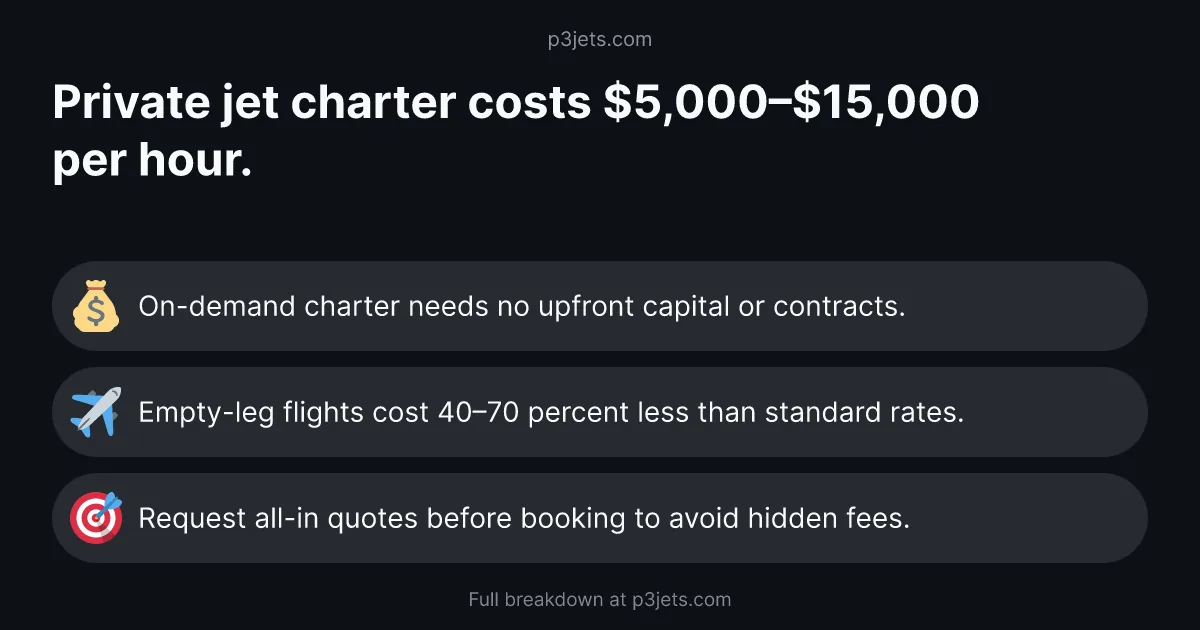
- On-demand private jet charter costs about $5,000 to $15,000 per flight hour from light to heavy jets, with no upfront capital commitment required.
- Jet cards are usually sold in 25-hour blocks, which at typical light to super midsize rates means roughly $120,000 to $250,000 upfront; fractional shares cost far more plus monthly fees.
- Repositioning, de-icing, overnight crew and peak-day premiums can add 10 to 30 percent to the final bill beyond the quoted hourly rate.
- Empty-leg flights typically sell 30 to 70 percent below standard charter when your schedule is flexible.
- Requesting an itemized, all-in quote before booking is the single most effective way to avoid cost surprises after you sign.
You've seen the numbers. Maybe a colleague mentioned what they paid for a weekend charter, or a jet card ad quoted an hourly rate that seemed almost reasonable. Now you're trying to work out whether private flights are genuinely within reach, or whether the sticker price is just the opening line of a much longer invoice.
That uncertainty is the real cost for first-time buyers. Not the fuel. Not the crew. The information gap. This guide breaks down every major pricing model for private jet charter, explains what hourly rates actually include, and shows where genuine savings exist in 2026.
Comparing Pricing Models for Private Flights
Private flights fall into three main pricing models, on-demand charter, jet cards and fractional ownership, and the right one depends almost entirely on how often you fly. Charter suits most people flying under about 25 hours a year, jet cards fit roughly 25 to 100 hours, and fractional ownership becomes defensible past about 100 hours a year.
| Pricing model | Upfront cost | How you pay | Best for |
|---|---|---|---|
| On-demand charter | None | Market rate per trip | Under about 25 hours a year |
| Empty legs | None | Discounted one-way repositioning flights | Flexible travelers on matching routes |
| Jet card | Prepaid block, often 25 hours | Fixed hourly rate by category | About 25 to 100 hours a year |
| Fractional ownership | Share purchase, often high six to seven figures | Monthly fee plus hourly rate | About 100 or more hours a year |
| Full ownership | Aircraft purchase | All crew, hangar, insurance and maintenance | Usually 200 or more hours a year |
Our charter vs. jet card vs. fractional guide maps each model to flight hours, and the jet card comparison shows how programs differ. P3 Jets helps clients match the model to their real travel patterns, not their hoped-for ones.
What Private Jet Hourly Rates Actually Include
The hourly rate most operators quote covers the aircraft, fuel, crew and basic handling, but it rarely includes the full picture. Aircraft category is the primary driver of cost. Knowing what sits inside that number, and what sits outside it, is the difference between a budget that holds and one that balloons after booking.
| Aircraft category | Typical seats | Hourly rate range | Ideal trip length |
|---|---|---|---|
| Turboprop | 6 to 8 | $3,900 to $5,200 | Up to about 2 hours |
| Light jet | 5 to 7 | $4,800 to $6,500 | Up to about 3 hours |
| Midsize jet | 7 to 9 | $6,200 to $8,000 | About 3 to 4 hours |
| Super midsize jet | 8 to 10 | $7,500 to $9,800 | About 4 to 6 hours |
| Heavy jet | 10 to 16 | $9,500 to $13,500 | About 5 to 10 hours |
| Ultra-long-range jet | 12 to 16 | $13,000 to $19,000 | Intercontinental nonstop |
These are approved 2026 market ranges before tax and fees; a specific aircraft's quote will vary with fuel, season and positioning. Rates on two quotes for the same category can differ meaningfully. For model-level detail, see the private jet cost per hour guide.
Hidden Fees Most Providers Don't Disclose
The gap between a quoted hourly rate and the final invoice is where trust breaks down. Repositioning is usually the biggest addition, followed by overnight crew, de-icing, handling fees and peak-day surcharges. Together these can add 10 to 30 percent to a trip, and on short one-way charters repositioning alone can rival the flight itself.
| Fee | Typical range | When it applies |
|---|---|---|
| Repositioning | $2,000 to $8,000 or more | The aircraft flies empty to your departure airport or back to base |
| Federal excise tax | 7.5 percent plus segment fees | U.S. domestic charter flights |
| Overnight crew | $500 to $1,500 per night | Crew stays at your destination |
| Landing and FBO handling | $100 to $1,000 or more | Varies by airport |
| De-icing | $500 to $3,000 | Winter operations |
| Peak-day surcharge | Varies by date | Holidays and major event weekends |
The tax rule is set out by the IRS. The most effective protection is simple: request an all-in quote. A solid broker itemizes every anticipated charge before you commit, and if a provider resists giving you a fully loaded number, that resistance answers a question you haven't asked yet. P3 Jets discloses every fee upfront as standard practice.
Affordable Ways to Fly Private
The cheapest private flights aren't cheaper because the aircraft are worse. They're cheaper because the economics of the route work differently. Empty legs, group charters, midweek dates and right-sized aircraft all lower cost, and the common thread is flexibility. The more you can bend on timing and airports, the more you save.
Empty legs are repositioning flights that operators fly regardless of whether a paying passenger is aboard. When an aircraft drops passengers in Miami and must return empty to New York, that return leg is pure cost to the operator, so it is often sold 30 to 70 percent below standard charter. Popular corridors like Northeast to Florida routes generate steady empty-leg inventory during seasonal migration.
The limitations are real. Inventory may surface only days or hours before departure, routes are fixed by the operator's schedule, the aircraft is whatever happens to be repositioning, and the flight can be cancelled if the original trip changes. Frankly, empty legs are a no-brainer for the right traveler but no substitute for a planned charter. Think of them as a bonus round. You can browse current empty legs or read the empty leg guide.
How to Book Your First Private Flight
Booking a private flight is simpler than most people expect. Domestic trips can often be arranged within a day or two, and sometimes within hours when an aircraft is nearby. The process comes down to three steps: define your trip, request itemized quotes and compare them carefully before confirming with a signed agreement.
- **Define your trip.** Pin down passenger count, baggage, departure and arrival cities, dates and how flexible you can be. Shifting a departure by even one day can move a quote out of peak-day pricing.
- **Request quotes.** Share those details with a charter advisor. A legitimate provider returns an all-in quote itemizing the aircraft, fuel, crew, landing and FBO fees, tax and any repositioning.
- **Compare and confirm.** Review at least two quotes side by side, checking the aircraft, the named operator, its safety rating and the cancellation terms.
Our first-time charter guide walks through each step, and the private jet charter near me guide explains how to use nearby airports and well-positioned aircraft to keep costs down.
Safety and Operator Vetting
Safety certification is the most important box to check in private aviation. Confirm the aircraft flies under an FAA Part 135 certificate, then look for a third-party audit from ARGUS or Wyvern, which review maintenance records, pilot training, insurance and operational history. Whether you book direct or through a broker, the operator should be named on every quote.
Booking through a broker is not a safety risk on its own; opacity is. A good broker compares many operators, shares each one's FAA certificate and ARGUS or Wyvern rating, and walks away from any that won't provide them. The NBAA also publishes resources for evaluating operators. Our operator vetting checklist and safety standards page go deeper.
Privacy, Sustainability and the Future of Private Aviation
For executives and high-net-worth families, privacy is often the main reason to fly private. Charter keeps your name off the aircraft registration, since public flight-tracking data ties tail numbers to registered owners rather than passengers. Sustainability is the other half of the conversation, and it deserves an honest answer rather than marketing.
Each private flight emits significantly more carbon dioxide per passenger than a commercial flight on the same route. That's an uncomfortable fact. The industry's response is measurable, if incomplete: more operators now buy sustainable aviation fuel where it is available, carbon offset programs let clients fund verified projects, and hybrid-electric prototypes are in testing. The practical step is to ask about sustainable fuel and offset options when you request a quote.
Your Next Move
The buyers who get the best value aren't the ones with the biggest budgets. They're the ones who ask the right questions before they sign. Start with your trip, not your budget: where you need to go, how many seats and bags you need, and how flexible your dates are. Then compare itemized quotes from at least two providers line by line.
P3 Jets treats transparency as a baseline, backed by our founder's 20+ years in aviation operations and brokerage. Every quote is itemized, every operator is named and vetted, and every itinerary is built around your trip. Request an itemized quote or call (844) 767-8370.
Sources and methodology
Pricing ranges reflect P3 Jets quote and booking records over a rolling twelve months. Regulatory and travel requirements are drawn from the primary sources below.