Key takeaways
- Empty legs typically run 30 to 70 percent below standard charter because you are buying a repositioning flight on someone else's schedule.
- The route, date, departure window and aircraft are set by the operator, and the paying client who created the leg always has priority.
- If the operator withdraws the leg, the charter agreement usually returns what you paid for that flight, but it rarely covers hotels, alternate flights or other costs you booked around it.
- Empty legs are one-way only, so the return trip needs its own plan before you commit.
- They suit flexible leisure travel. Weddings, closings, cruise departures and medical appointments belong on a standard charter.
An empty leg is one of the best deals in private aviation, and one of the most misunderstood. The price is real. So are the strings attached. You're not commissioning a flight; you're buying a seat on an aircraft that has to fly a specific route at a specific time whether you're on board or not.
That framing explains every restriction that follows. Once you understand that you're buying someone else's schedule at a discount, the rules stop feeling arbitrary, and you can decide quickly whether a given leg fits your trip. Here is what every buyer should know before paying for one.
What Are the Main Restrictions on Empty Leg Bookings?
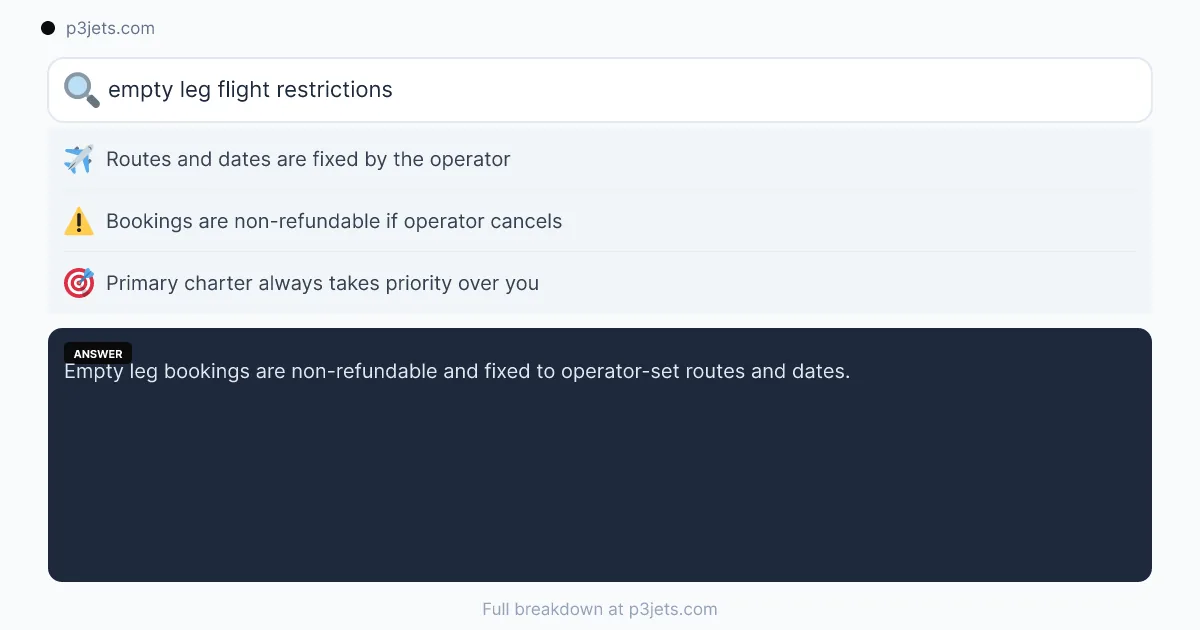
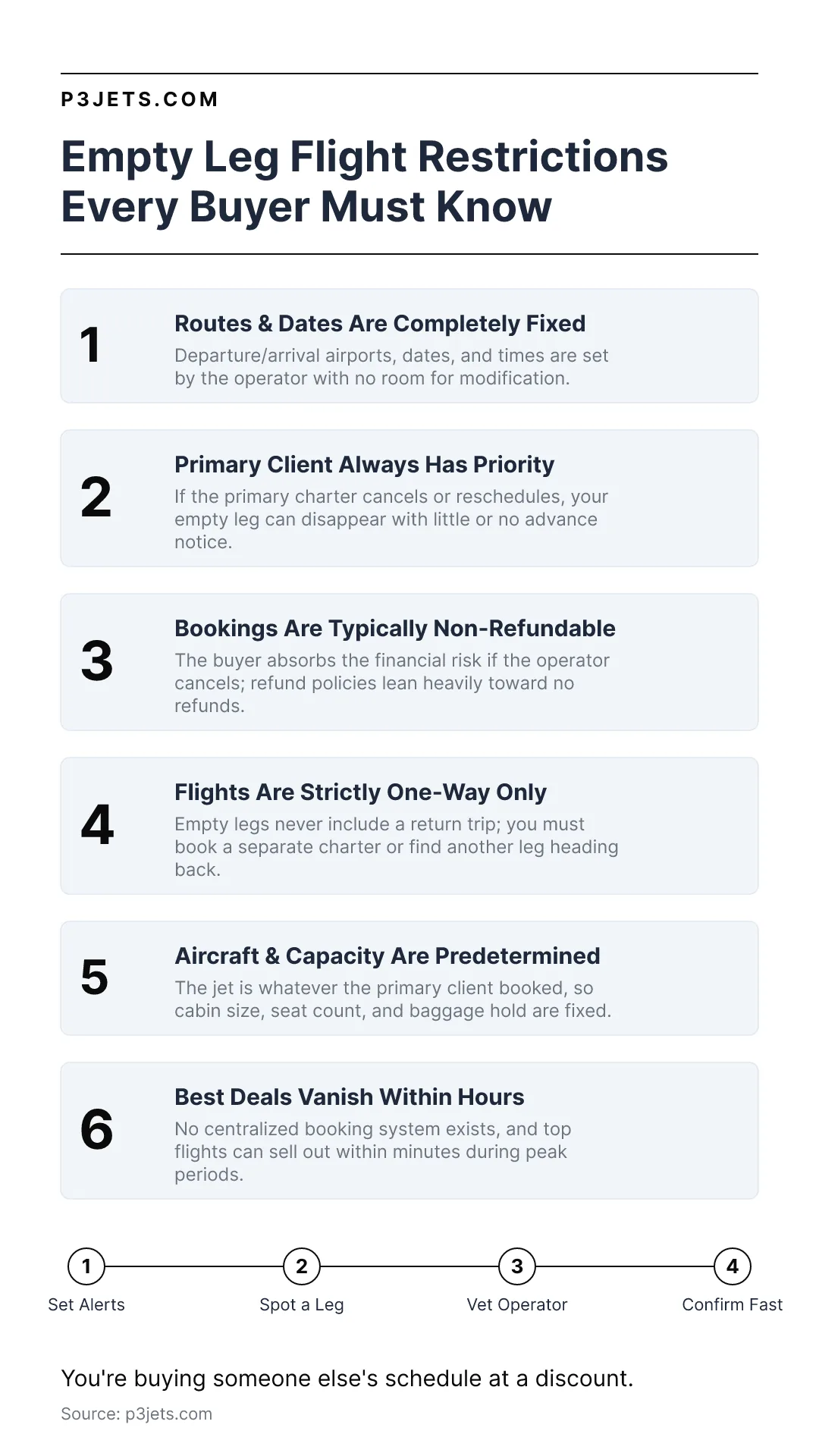
The main restrictions are a fixed route and departure window, priority for the paying client who created the leg, limited refund rights, one-way travel only, a predetermined aircraft and short availability. In exchange, empty legs typically run 30 to 70 percent below standard charter. Every rule traces back to the same fact: the flight exists for someone else's trip.
| Restriction | What it means for you | How to work with it |
|---|---|---|
| Fixed route and date | Departure and arrival airports and the day are set by the operator | Search by region, not a single airport, and stay flexible on dates |
| Primary client priority | If the original trip moves or cancels, your leg can move or disappear | Keep a backup plan until the day of departure |
| Limited refunds | Terms favor the operator; your own cancellation is usually nonrefundable | Read the charter agreement before you pay |
| One-way only | No return flight is included | Price the return separately or watch for a matching leg back |
| Fixed aircraft and capacity | Seats, cabin size and baggage space are whatever was positioned | Confirm passenger count, bags and pets before booking |
| Short availability | Good legs often sell within hours of posting | Set route alerts and have passenger details ready |
None of these are hidden traps. Reputable operators and brokers disclose them up front, and our own terms of service state plainly that empty legs can change, reroute or cancel before departure. The buyers who get burned are usually the ones who treated an empty leg like a standard charter at a lower price.
Why the Primary Charter Always Comes First
The primary charter comes first because that client is paying full price for the trip that created the repositioning flight. If they change their departure time, extend their stay, switch aircraft or cancel, the empty leg changes with them. The operator's obligation runs to the paying client, so your discounted leg is always the flexible piece of the schedule.
In practice, most empty legs fly as posted. The risk is real but uneven: legs created by a confirmed one-way drop-off a day or two out are fairly stable, while legs posted a week or more ahead have more time for the original plan to change. Ask your advisor how firm the underlying trip is. A good one will tell you honestly.
Departure times can also shift by an hour or two in either direction when the primary trip moves. If you're connecting to a dinner reservation or a ferry, build in slack. Our last-minute empty leg booking guide covers how timing works once a leg posts.
Refunds, Cancellations and Who Carries the Risk
If the operator withdraws an empty leg, the charter agreement usually returns what you paid for that flight, but it rarely covers hotels, alternate flights or other costs you booked around it. If you cancel, expect the payment to be nonrefundable once the leg is confirmed. The discount is the trade: you accept more schedule risk than a standard charter carries.
| Scenario | What usually happens | How to protect yourself |
|---|---|---|
| Operator withdraws the leg before departure | Payment for that leg is returned under the agreement | Confirm refund terms in writing before you pay |
| Primary trip shifts departure time | Your leg moves with it, sometimes by a few hours | Avoid tight connections on the other end |
| You cancel after confirming | Usually nonrefundable | Only confirm once your own plans are firm |
| Weather or maintenance delay | Handled as with any charter; safety decides | Ask what alternatives the operator offers |
| Leg cancels and you still need to travel | No replacement at the discounted price | Ask your advisor to price a standard charter immediately |
Posted empty leg prices and times aren't guaranteed until a charter agreement is signed, and the federal excise tax described by the IRS applies just as it does on a standard domestic charter. Read the cancellation section of the agreement line by line. If anything is vague, ask for it in writing before you send payment.
The most expensive mistake isn't losing the leg itself. It's the nonrefundable hotel, the event tickets or the connecting flight booked around it. Hold those until the leg is confirmed, or choose refundable options.
Fixed Aircraft, Capacity and Baggage Limits
With an empty leg, the aircraft is whatever the primary client booked, so the seat count, cabin size and baggage hold are already decided. You can't upgrade to a larger jet or add a seat beyond the aircraft's limit. Before you book, confirm passenger count, total bags, golf clubs, skis and any pets against that specific aircraft.
You still book the whole aircraft. At P3 Jets an empty leg is a full charter sold at a discount, never a per-seat product, so the cabin is yours and the price doesn't change when you add passengers within the aircraft's limits. Light jets fill up fast on baggage, so a group of five with ski bags may need a midsize even if five seats are available.
Pets are possible on many empty legs with operator approval, but pet fees may apply and some operators limit animals in the cabin. Our pet-friendly charter guide explains what to ask. Catering and ground transport can usually be added, though short-notice legs leave less time to arrange them.
One-Way Only: Planning the Return Trip
Empty legs are strictly one-way, because they exist to move an aircraft from where it dropped a client to where it needs to be next. No return flight is included. Before committing, decide how you'll get home: a matching empty leg back, a standard one-way charter, or a commercial flight. Pricing the return first prevents an expensive surprise.
Popular corridors produce legs in both directions at predictable times of year. Florida sees heavy southbound demand in December and northbound repositioning in spring, and the reverse pattern creates empty legs. Ski markets and summer destinations in the Northeast follow similar seasonal waves, covered in our empty leg savings guide.
If no leg appears for the return, a standard one-way charter is often more reasonable than people expect, especially when an aircraft is already positioned near your destination. The combined cost of a discounted leg out and a one-way charter back frequently beats a round-trip charter.
Empty Leg vs. Standard Charter: Which Fits Your Trip?
Choose an empty leg when your dates, airports and departure time can flex and missing the flight would be an inconvenience rather than a crisis. Choose a standard charter when the trip has a fixed commitment on the other end. The discount only makes sense when you can live with the restrictions that create it.
| Factor | Empty leg | Standard charter |
|---|---|---|
| Price | Typically 30 to 70 percent below standard charter | Market rate for the aircraft and route |
| Route and timing | Set by the operator | Set by you |
| Aircraft choice | Whatever is positioned | Matched to your group and bags |
| Return flight | Not included | Round trip or one-way, your choice |
| Cancellation risk | Can move or cancel if the primary trip changes | Low; the aircraft is contracted to you |
| Best for | Flexible leisure trips and spontaneous getaways | Weddings, closings, medical travel and fixed events |
Many of our clients use both: a standard charter for the trip that has to happen on time, and empty legs for the getaways that can move. Our empty legs explained guide covers how legs are created and priced.
How to Book an Empty Leg Without Getting Burned
Book an empty leg in four steps: set alerts for the routes you care about, act quickly when a matching leg posts, verify the operator's safety credentials, and confirm the charter agreement in writing before you pay. Having passenger names, IDs and baggage counts ready in advance is what lets you move fast when a good leg appears.
- **Set alerts.** Tell your advisor your home airport, favorite destinations and travel windows, or watch the P3 Jets empty legs board.
- **Spot a leg.** Search by region, not a single airport. A leg into a nearby field can save more than it costs in drive time.
- **Vet the operator.** The flight should operate under an FAA Part 135 certificate, ideally with an ARGUS or Wyvern rating. A discount never justifies a lower safety standard.
- **Confirm fast.** Review the agreement, check the cancellation and refund language, then sign and pay. The best legs rarely wait.
There is no single central marketplace for empty legs. Operators post them on their own systems and share them with brokers, which is why a well-connected advisor often sees a leg before it reaches public listings. Our operator vetting checklist shows what to check on any aircraft you book.
Your Next Move
Empty legs reward travelers who know the rules and can move quickly. If your dates can flex, tell us where you like to fly and when, and we'll watch for legs that match. If the trip can't move, we'll quote a standard charter so you're never relying on someone else's schedule.
Browse current empty legs, request a quote or call (844) 767-8370 to talk with an advisor.
Sources and methodology
Pricing ranges reflect P3 Jets quote and booking records over a rolling twelve months. Regulatory and travel requirements are drawn from the primary sources below.