Key takeaways
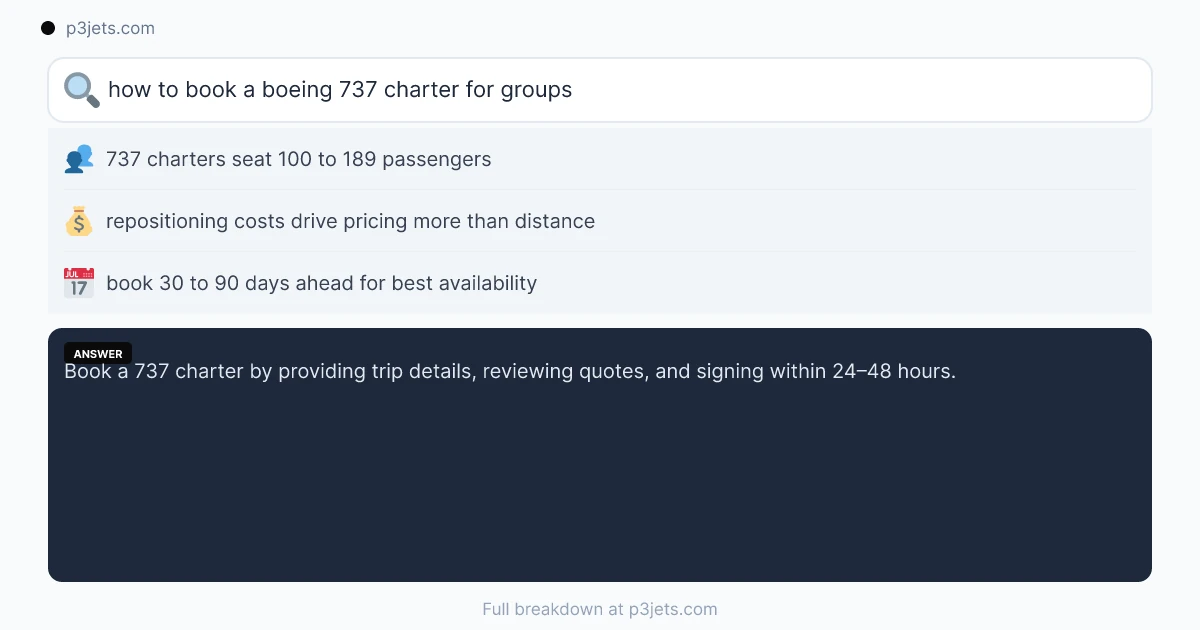
- A chartered Boeing 737 typically seats 100 to 189 passengers depending on configuration, making it one of the most practical aircraft for large groups in 2026.
- Repositioning, meaning how far the aircraft must fly empty to reach your departure airport, often moves the price more than the distance of your own trip.
- Plan at least 30 to 45 days ahead for domestic 737 charters and 60 to 90 days for peak-season or international trips, because the large-aircraft charter fleet books early.
- Vet the operator before comparing prices: airliners with more than 30 seats generally fly under an FAA Part 121 certificate, and insurance and safety history should be verified.
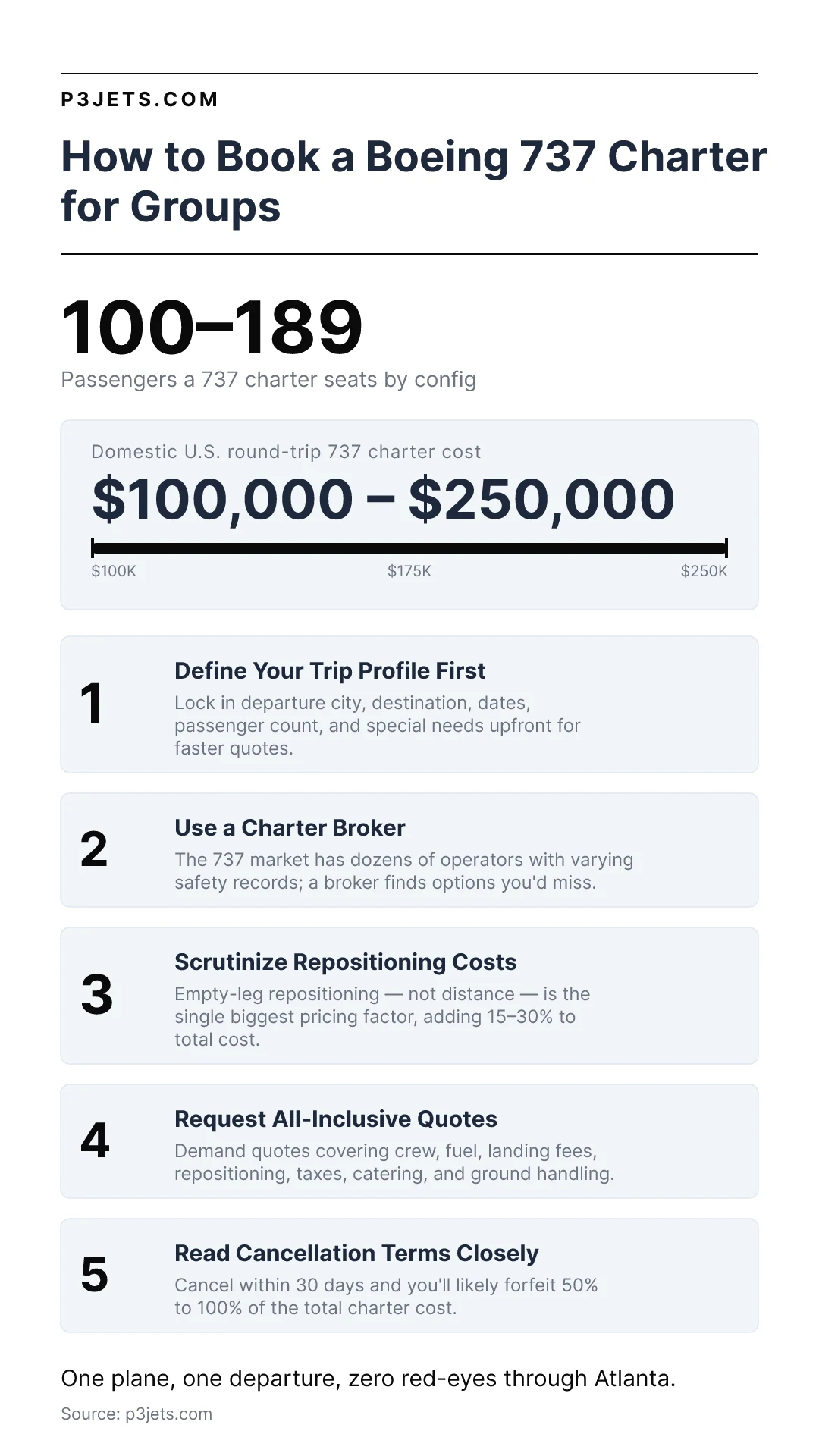
- A domestic round trip on a 737-800 commonly runs $100,000 to $250,000, or about $625 to $1,560 per person with 160 passengers aboard.
You've got 150 people who need to be in the same place at the same time. Commercial flights mean scattered itineraries, missed connections and that one group of twelve who somehow ended up on a red-eye through Atlanta. So you've thought: what if we just chartered the whole plane?
Good instinct. A Boeing 737 charter is how sports teams, corporate groups and incentive travel planners move large groups together. But the process isn't as simple as calling a number. Here's the paradox: the bigger the plane, the more personalized the planning needs to be, and the decisions made in the first 48 hours shape most of the outcome.
How Do I Book a Boeing 737 Charter for Group Travel?
How do I book a Boeing 737 charter for group travel? Share your route, dates, passenger count and onboard needs with a charter provider such as P3 Jets, compare all-inclusive quotes from vetted operators, then sign the contract and pay the deposit. Quotes can come back within 24 to 48 hours, but booking 30 to 90 days ahead secures the best aircraft.
The 737 family is one of the most widely operated narrow-body aircraft in the world, according to Boeing's Commercial Market Outlook, and that translates directly into charter availability: more aircraft in service means more operators and more configuration choices. For group charter, the 737 hits a sweet spot between capacity and per-seat cost.
Boeing 737 Seating and Cabin Configurations
A standard 737-800 in all-economy charter configuration seats 162 to 189 passengers. Mixed layouts with business class forward bring capacity to about 120 to 140, premium layouts popular with sports teams seat roughly 50 to 80, and executive BBJ-style cabins carry about 19 to 25. Choose the configuration before you compare prices.
| Configuration | Seat count | Best for | Relative cost |
|---|---|---|---|
| All economy | 162 to 189 | Budget-conscious large groups, tour groups | Lowest per seat |
| Mixed class | 120 to 140 | Corporate retreats, incentive travel | Moderate |
| Premium or sports layout | 50 to 80 | Pro and college teams, executive groups | High per seat |
| Executive BBJ-style cabin | 19 to 25 | Senior leadership, VIP delegations | Highest per seat |
| Custom hybrid | Varies | Groups with equipment or extra baggage | Case by case |
Under about 80 people, a 737 may be more aircraft than you need, and a VIP regional jet or smaller executive airliner can cost less; our group charter vs. multiple jets guide compares those options. Between 100 and 189, you're in the 737 sweet spot. Above 189, you're into wide-body territory or two aircraft.
The Five-Step 737 Charter Booking Process
Booking a 737 charter follows five steps: build the trip profile, identify suitable operators, review all-inclusive quotes, sign the contract and pay the deposit, then coordinate manifests, catering and equipment before departure. Most delays come from vague trip details in step one, so the more specific you are upfront, the faster accurate quotes arrive.
**Step one: the trip profile.** Departure city, destination, dates, passenger count and special requirements such as oversized equipment, catering or ground transport. Flexible departure airports or dates are worth mentioning here, because they can open up lower-cost aircraft.
**Step two: operator identification.** This is where an experienced charter broker pays for itself. The large-aircraft charter market includes many operators with varying safety records and fleets. Going direct without industry knowledge is like shopping for commercial real estate without a broker: you can do it, but you'll likely miss options and overpay.
**Step three: quote review.** You'll typically receive two to four quotes with inconsistent line items. Ask for all-inclusive pricing covering aircraft and crew, fuel, landing and handling fees, repositioning, overnight crew expenses, the 7.5 percent federal excise tax on domestic U.S. flights, per-passenger segment fees, catering and ground handling.
**Steps four and five** cover the contract, the deposit and pre-flight coordination, explained in detail below.
What Drives Boeing 737 Charter Pricing
The biggest factor in 737 charter pricing is often repositioning, not trip distance: how far the aircraft must fly empty to reach your departure airport and return afterward. A group flying Miami to Cancun might pay less than a group flying Omaha to Denver simply because the available 737 is already based in South Florida.
| Pricing factor | Impact on total cost | Can you control it? |
|---|---|---|
| Repositioning distance | High; often 15 to 30 percent of the total | Partly, with a flexible departure city |
| Fuel prices | Moderate; fluctuates monthly | No, but booking timing helps |
| Peak vs. off-peak dates | Moderate; often a 10 to 20 percent premium | Yes, with flexible dates |
| Airport fees | Low to moderate | Yes, with alternate airports |
| Cabin configuration | Moderate | Yes, chosen at booking |
| International vs. domestic | Moderate; customs and overflight fees | Depends on the itinerary |
For a domestic U.S. round trip on a standard 737-800 in 2026, expect roughly $100,000 to $250,000 depending on route, repositioning and season. Divided among 160 passengers, that is about $625 to $1,560 per person round trip, often competitive with 160 individual commercial tickets on routes with limited nonstop service. Final pricing always comes from a written operator quote.
Counterintuitively, the cheapest time to charter a 737 isn't always the off-season. It's whenever an operator needs to move an aircraft along your route anyway, the large-aircraft version of an empty leg. Those opportunities are rarer for airliners than for smaller jets, so flexible dates help an advisor spot one.
Contracts, Deposits, and Pre-Flight Coordination
Many large-aircraft operators require a deposit of 25 to 50 percent at signing, with the balance due 14 to 30 days before departure. Read the cancellation terms closely: cancelling within 30 days of departure commonly forfeits 50 to 100 percent of the charter price, and those terms are where buyers most often spend too little time.
Before you sign, confirm the operator's certificate. Airliners configured with more than 30 passenger seats generally operate under FAA Part 121 rather than the Part 135 rules used for smaller charter jets. Ask for the operator name, certificate details and proof of insurance, and check that both airports can accept a 737 using FAA airport data.
**Pre-flight coordination** covers passenger manifests, catering menus, branded cabin touches and equipment. Need 40 sets of golf clubs or a team's equipment trunks aboard? Flag it early so the operator can plan weight and balance. Frankly, the groups whose trips run smoothest are the ones who send the manifest and bag counts on time.
Your Next Move for a Large-Group Charter
To start, you need a headcount, a route, a date range and a clear picture of what your group needs onboard. Everything else is the operator's and broker's job. Begin the inquiry 30 to 90 days out, share the full picture, and let your advisor build the flight around it.
One plane, one departure, one arrival. The best aircraft and pricing go to groups who plan ahead. Request a group quote or call (844) 767-8370 with your passenger count, route and dates.
Sources and methodology
Pricing ranges reflect P3 Jets quote and booking records over a rolling twelve months. Regulatory and travel requirements are drawn from the primary sources below.