Key takeaways
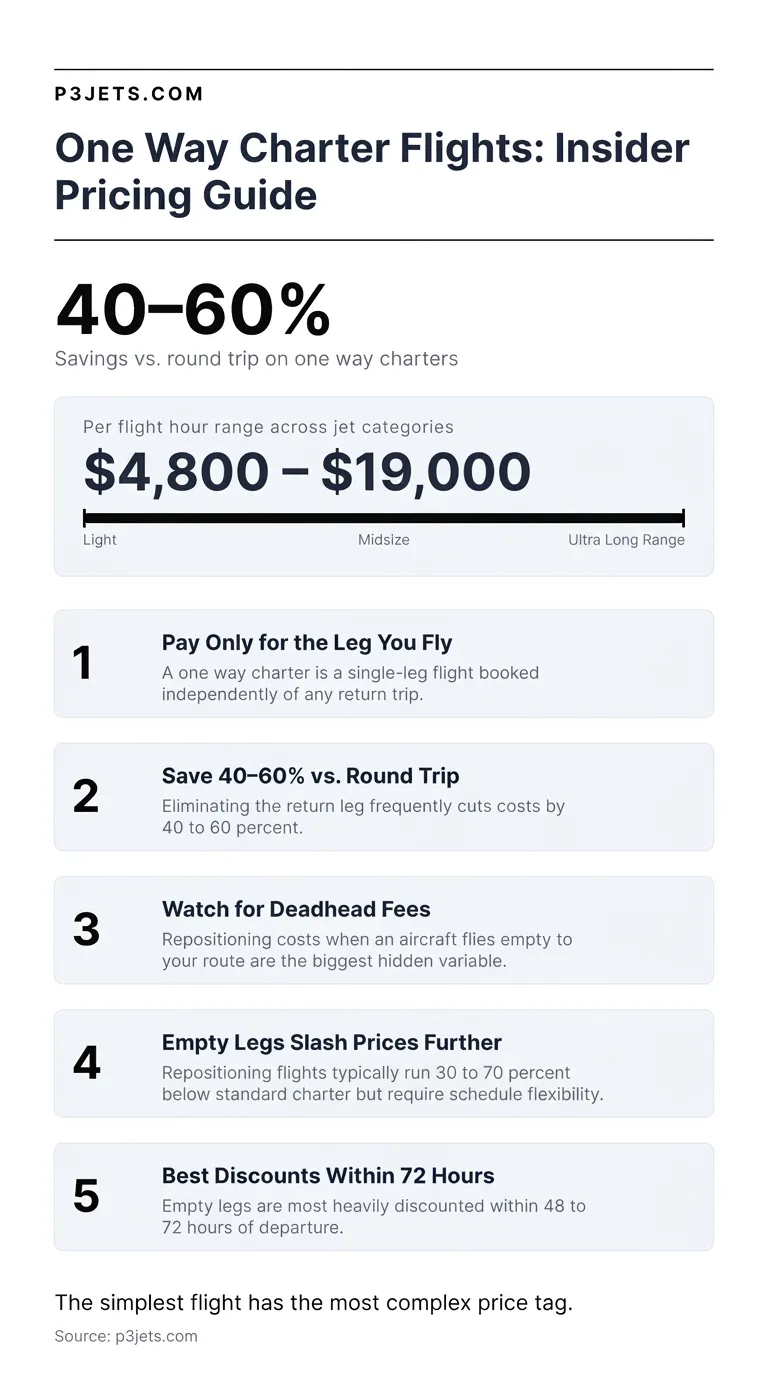
- A one way private jet charter is a single-leg flight booked independently of any return trip, meaning you pay only for the route you actually fly.
- One way charters frequently cost 40 to 60 percent less than a full round trip because you eliminate the return leg entirely.
- Deadhead fees, the repositioning costs operators charge when an aircraft must fly empty to or from your route, are the single biggest hidden variable in one way charter pricing.
- Empty leg flights typically run 30 to 70 percent below standard charter pricing, but they require schedule flexibility and expert guidance to book reliably.
- Working with a broker who discloses the full pricing breakdown is the most reliable way to avoid overpaying on a one way flight.
A managing director in Dallas needed to reach Teterboro by 9 a.m. Tuesday. No return trip planned. Three operators gave three wildly different quotes. The difference came down to repositioning: one had an aircraft already at Dallas Love Field, another would've flown a jet in from Houston, and the third quoted a round trip with the return leg baked in despite her not needing one.
That scenario plays out hundreds of times weekly. In 2026, with private jet charter costs under more scrutiny than ever, understanding one way charter flights isn't optional for anyone spending real money on aviation.
Here's the paradox: the simplest type of charter, a single leg from A to B, has the most involved pricing structure.
What Are One Way Charter Flights
**One way charter flights** let you book a single leg without paying for a return trip or idle aircraft time. P3 Jets connects travelers with competitively positioned jets, minimizing repositioning fees that can inflate one-way quotes. Whether you're an executive, a family, or a travel advisor planning a single-route itinerary, this model delivers flexibility and cost transparency from inquiry to wheels up.
How Much Does a One Way Private Jet Charter Cost
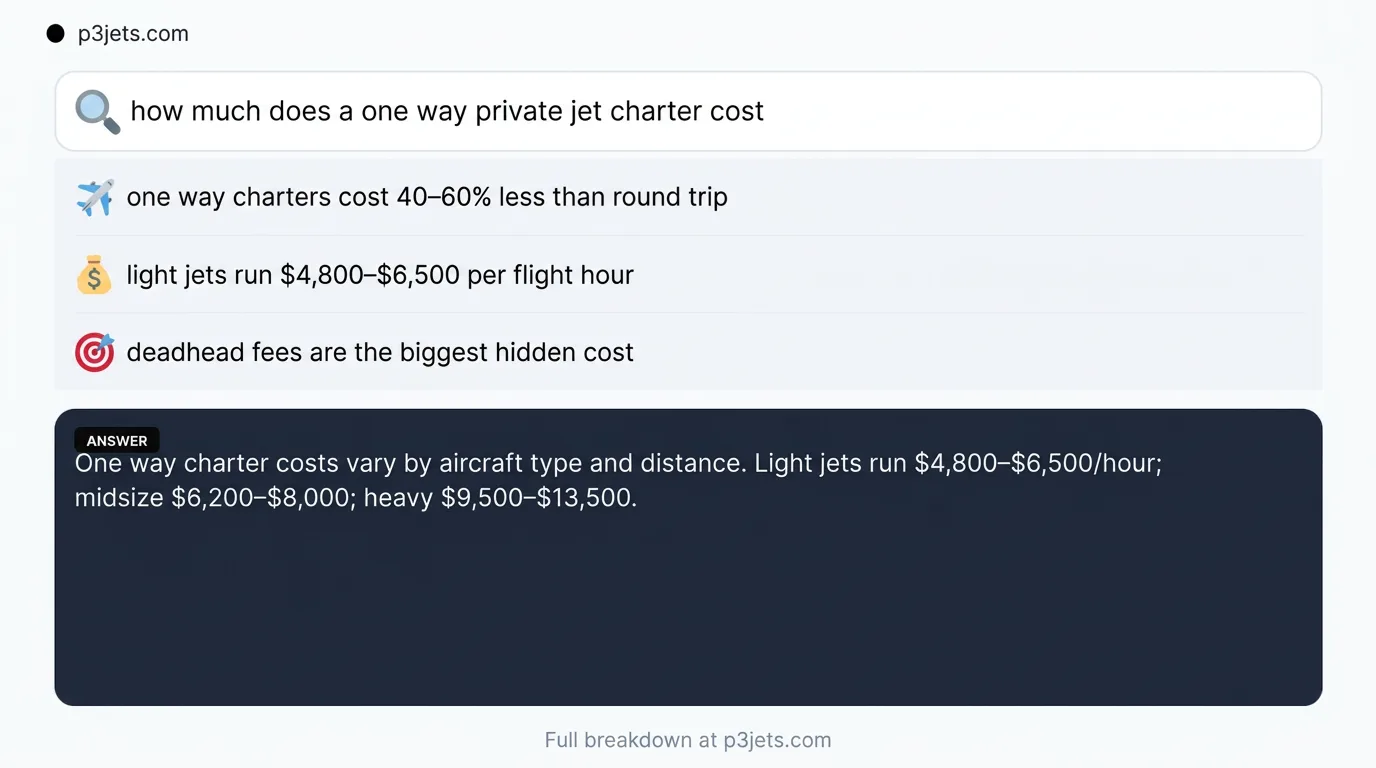
One way charter pricing in 2026 varies by aircraft category, route distance, and demand. Light jets typically run $4,800 to $6,500 per flight hour. Midsize jets fall between $6,200 and $8,000. Heavy jets run $9,500 to $13,500, and ultra-long-range jets reach $19,000. P3's own managed fleet starts at $6,500 per flight hour all-in, and our private jet cost calculator gives a route-specific range in seconds.
| Pricing factor | How it affects your quote |
|---|---|
| Distance | More flight hours billed at the hourly rate |
| Aircraft size | Larger cabins cost more per hour but reduce cost per seat |
| Demand and positioning | Peak days and remote airports increase repositioning fees |
| Fuel surcharges | Jet-A pricing fluctuates regionally and seasonally |
| Landing and handling fees | Major hubs charge more than regional fields |
For a detailed breakdown, the P3 Jets cost guide covers the full picture. Brokers like P3 Jets who maintain relationships with hundreds of operators can surface the lowest repositioning rates on any given route, often beating the prices listed on aggregator platforms.
One Way vs. Round Trip Price Comparison
In private aviation, a single one way charter frequently costs 40 to 60 percent less than a full round trip because you eliminate the return leg entirely, though two separate one way bookings rarely beat a round trip unless both legs align with existing empty leg inventory.
| Booking type | Estimated cost (midsize, NY to Miami) | What you pay for |
|---|---|---|
| Round trip charter | $38,000 to $48,000 | Both legs plus aircraft wait time |
| One way (no deadhead) | $16,500 to $22,000 | Single leg, aircraft already nearby |
| One way (with deadhead) | $21,000 to $29,000 | Single leg plus repositioning |
| Empty leg (if available) | $5,000 to $15,000 | Repositioning flight, 30 to 70 percent below standard charter |
One way charters are almost always cheaper than round trips when your return date is uncertain, when you can match an empty leg route, or when you simply do not need the aircraft to wait or reposition for a return flight.
According to the National Business Aviation Association, the average business aviation flight in North America covers roughly 900 nautical miles, a distance where one way pricing advantages are most pronounced. The verdict: if you know both dates with certainty, a round trip can offer better per-leg economics. If you don't, you're paying for flexibility you aren't using.
Empty Leg Flights and Last-Minute Deals
Empty leg flights are repositioning flights that operators must fly regardless of whether a paying passenger is on board, and they typically sell at 30 to 70 percent below standard charter pricing. When a client books a one way charter from Chicago to Palm Beach, the aircraft often needs to return to base. That return segment is dead cost for the operator unless someone books it.
The empty leg flights explained guide covers the mechanics in detail. P3 Jets maintains a live empty leg listings page with transparent pricing. Empty legs are most heavily discounted within 48 to 72 hours of departure.
But the trade-off is real. You can't change the departure city or shift the time by more than a narrow window. And if the original booking cancels, your flight cancels too.
Who gets the most value: travelers with flexible schedules flying common corridors like New York to Florida or LA to Vegas. Who should think twice: anyone with a non-negotiable departure time. For those travelers, a dedicated one way charter is worth its weight in gold, even at the higher rate. Frankly, the smartest approach is asking your broker to quote both options side by side.
Safety and Booking Your One Way Charter
Aviation safety doesn't vary by trip type. A one way charter operates under the same regulatory framework, crew requirements, and maintenance standards as any round trip. P3 Jets screens every operator for FAA certification, valid insurance, and documented pilot experience, then cross-references third-party audits from ARGUS and Wyvern.
Here's the paradox of one way charter booking: the simpler the trip, the more important the broker's process becomes. Round-trip clients build a relationship across multiple legs. One way travelers get a single interaction, so every detail needs confirming upfront. A thorough jet rental guide walks through vetting standards that separate reputable services from those cutting corners.
Every jet charter is exclusive to the booking party. No seat sharing, no strangers. A family of four fits comfortably in a light jet; six or more passengers typically need a midsize cabin. Your broker should walk you through layouts and baggage capacity before you commit.
| Aircraft category | Hourly rate range (2026) | Best for |
|---|---|---|
| Very light jet | $4,200 to $5,600 | Short hops under 2 hours, 4 to 5 passengers |
| Light jet | $4,800 to $6,500 | Regional routes, 6 to 7 passengers |
| Midsize jet | $6,200 to $8,000 | Cross-country, 7 to 8 passengers |
| Super midsize jet | $7,500 to $9,800 | Coast-to-coast, 8 to 9 passengers |
| Heavy jet | $9,500 to $13,500 | International, 10 to 14 passengers |
| Ultra long range | $13,000 to $19,000 | Intercontinental, 12 to 16 passengers |
A New York to Miami light jet charter runs roughly 2.5 hours, putting airtime cost between $12,000 and $16,250 before fees.
Why Choose P3 Jets for One Way Charter Flights
P3 Jets treats one way charter flights as a consultative service, not a transaction. Every quote includes a transparent breakdown of positioning fees, fuel surcharges, and landing costs. The brokerage maintains access to a global fleet with real-time empty leg inventory, so single-route travelers can compare dedicated charters against discounted repositioning flights in the same conversation.
The one way charter market in 2026 rewards informed buyers. Repositioning fees, empty leg availability, and aircraft selection shift daily. Explore current empty leg availability or request a quote with your route and date. You'll get a breakdown showing every line item, no guesswork required.
Sources and methodology
Pricing ranges reflect P3 Jets quote and booking records over a rolling twelve months. Regulatory and travel requirements are drawn from the primary sources below.