Key takeaways
- A private jet charter quote is a detailed cost proposal covering aircraft hourly rate, fuel surcharges, landing and handling fees, crew overnight expenses, federal excise tax, and any ancillary services like catering or ground transportation.
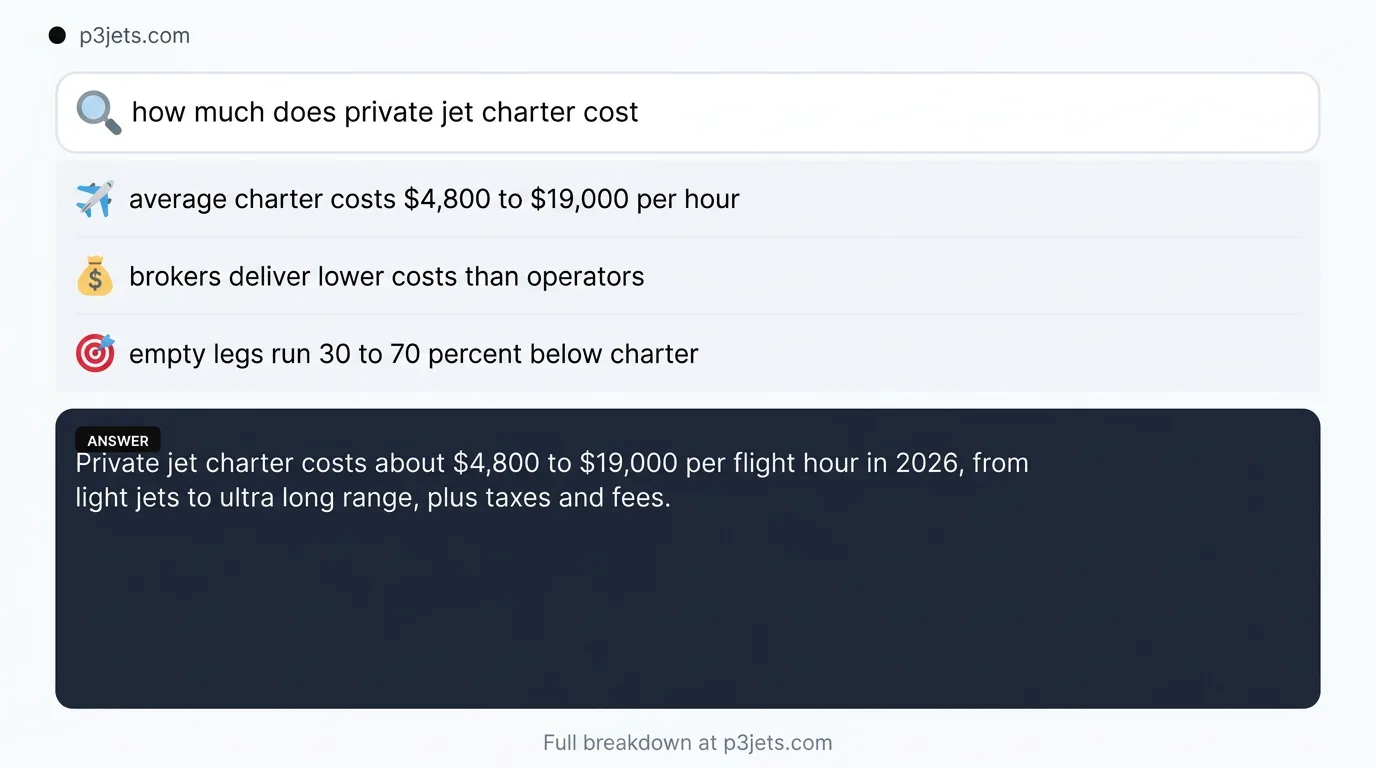
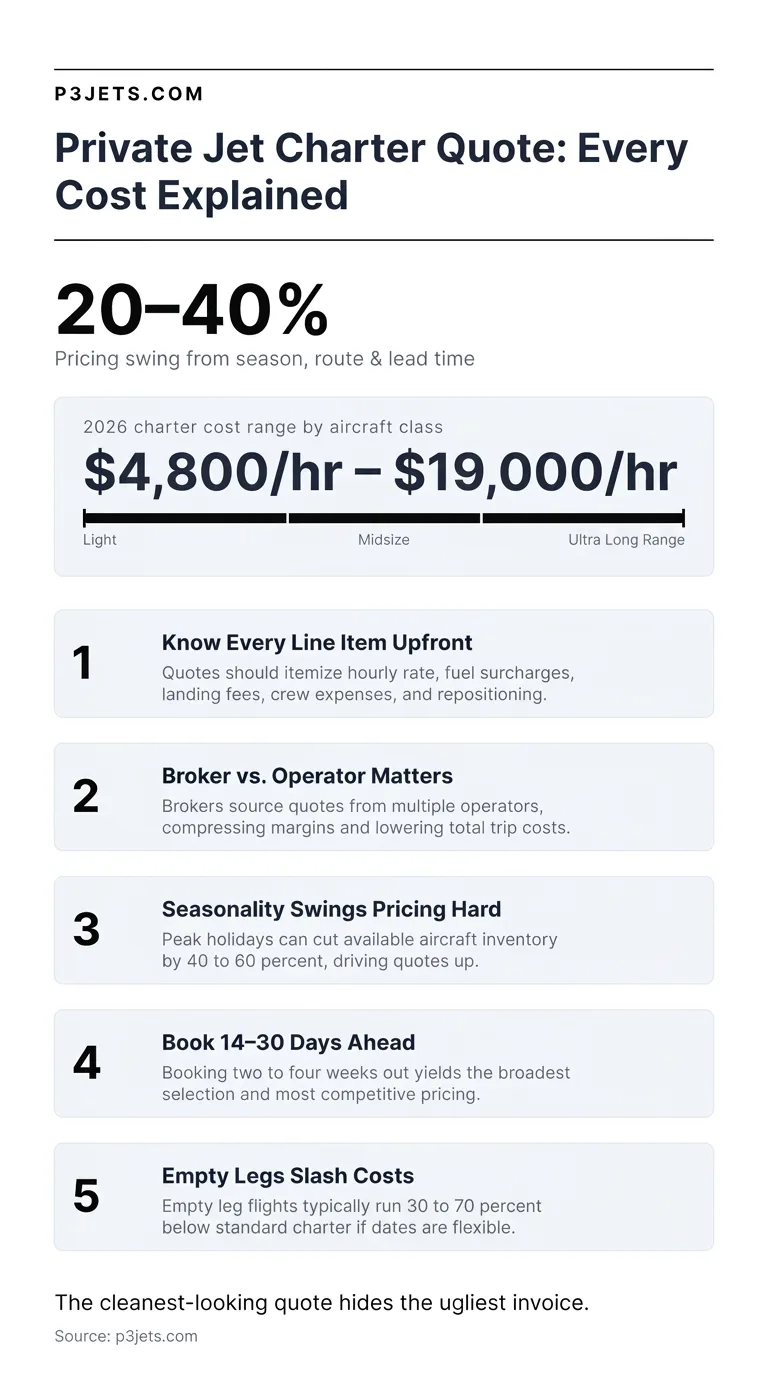
- Market charter in 2026 runs from about $4,800 per flight hour for a light jet to $19,000 for an ultra-long-range jet, with turboprops starting near $3,900. P3's own managed fleet starts at $6,500 per flight hour all-in.
- Brokers who source quotes from multiple operators on your behalf consistently deliver lower total trip costs than going direct to a single operator, because competition between carriers compresses margins.
- Seasonality, route demand, and booking lead time can shift a charter quote by 20 to 40 percent on the same aircraft for the same route.
- Empty leg flights typically run 30 to 70 percent below standard charter pricing, but they require flexible dates, times, and sometimes destinations.
Most private jet charter quotes are designed to look simple. That's the problem.
A clean number on a PDF feels reassuring until the final invoice arrives 8 to 12 percent higher. Fuel surcharges that weren't itemized. Repositioning fees buried in fine print. According to a 2024 analysis by Aviation International News, post-quote cost escalation remains one of the most common complaints among charter clients. If you're comparing proposals for the first time, our step-by-step chartering guide walks through the entire process.
What a Private Jet Charter Quote Actually Includes
A **private jet charter quote** from a trusted provider like P3 Jets should itemize every cost: hourly rate, fuel surcharges, landing fees, crew expenses, and repositioning, so you can compare proposals with full transparency. If a quote looks suspiciously low, it likely hides fees that a more detailed breakdown would reveal upfront.
Charter Broker vs. Operator: How Each Affects Your Quote
The best private jet charter company is one that sources quotes from multiple operators on your behalf, compares proposals across safety record, aircraft age, and total trip cost, and explains every line item before you commit.
An **operator** owns or manages aircraft under a Part 135 certificate. You see pricing for their planes only. A **broker** doesn't own aircraft but sources quotes from multiple operators and presents the strongest options. The biggest private jet charter companies by fleet access are broker networks that tap into thousands of aircraft across dozens of Part 135 operators, rather than single-operator fleets limited to their own planes. For a deeper look, see our broker vs. operator comparison.
Chartering a private jet is worth it when the time savings, schedule flexibility, and privacy justify the cost relative to commercial alternatives, particularly for trips where connections, delays, or airport logistics would consume three or more additional hours. A broker's role is to ensure you're capturing that value at the best available price.
| Comparison factor | What to check | Red flag |
|---|---|---|
| Aircraft category match | Same class (light, midsize, heavy) | Comparing a light jet quote to a midsize |
| Repositioning included | Deadhead leg priced in or excluded | "Repositioning TBD" or no mention |
| Fuel surcharge method | Percentage vs. flat rate vs. included | No fuel line item visible |
| Crew overnight | Included for multi-day trips | Missing on overnight trips |
| Taxes and fees | FET and segment fees itemized | "Taxes additional" with no estimate |
| Cancellation terms | Penalty structure and timeline | No cancellation policy provided |
How Seasonality, Route Demand, and Lead Time Shift Pricing
A private jet charter to Florida from the Northeast typically costs between $17,000 and $22,000 one way on a midsize jet in 2026, though peak-season surcharges during winter months and holidays can push that range 20 to 35 percent higher. Three variables move the needle most.
**Seasonality** creates predictable pricing patterns. According to the National Business Aviation Association, peak-day demand during holidays can reduce available aircraft inventory by 40 to 60 percent in popular markets. Fewer planes means higher quotes. Our demand and surcharge guide covers specific booking windows.
**Route demand imbalance** is the factor most clients don't anticipate. When hundreds of travelers fly New York to Palm Beach in December, aircraft return north empty, creating repositioning costs passed to the next client or empty leg opportunities for flexible travelers.
**Lead time** directly correlates with pricing power. Booking 14 to 30 days ahead typically yields the broadest selection and most competitive pricing. Booking 48 hours out limits options, and scarcity commands a premium. For anyone flying fewer than 300 to 400 hours per year, chartering is cheaper than owning a private jet once you account for hangar fees, crew salaries, insurance, maintenance reserves, and depreciation. But chartering smart, with adequate lead time, is cheaper still.
Empty leg flights typically run 30 to 70 percent below standard charter pricing, but they require flexible dates, times, and sometimes destinations. Flexibility is the currency that buys affordability in private aviation. Our empty leg flights guide explains how to find these opportunities.
Private Jet Hourly Rates by Aircraft Class
Private jet cost per flight hour in 2026 ranges from approximately $3,900 for a turboprop to $19,000 for an ultra-long-range aircraft. For current figures, consult the P3 Jets hourly rate guide, or get a route-specific range in seconds with our private jet cost calculator.
| Aircraft class | Hourly rate (2026) | Passengers | Practical nonstop range | Best for |
|---|---|---|---|---|
| Turboprop | $3,900 to $5,200 | 6 to 8 | 600 to 900 nm | Short regional hops |
| Light jet | $4,800 to $6,500 | 6 to 7 | 1,100 to 1,500 nm | City pairs under 3 hours |
| Midsize jet | $6,200 to $8,000 | 7 to 8 | 1,800 to 2,300 nm | Cross-country, stand-up cabins |
| Super midsize | $7,500 to $9,800 | 8 to 9 | 2,800 to 3,400 nm | Coast-to-coast nonstop |
| Heavy jet | $9,500 to $13,500 | 10 to 14 | 3,600 to 4,500 nm | International, full amenities |
| Ultra long range | $13,000 to $19,000 | 12 to 16 | 6,000+ nm | Transatlantic, transpacific |
P3's own managed fleet is priced all-in per flight hour, starting at $6,500 for the Falcon 50. You can see every model and its rate on our instant book page.
Here's the paradox of private jet pricing for solo travelers: you're paying for an entire cabin whether you fill one seat or eight. Solo travelers should focus on light jets and turboprops for trips under 1,500 nautical miles, cutting costs roughly in half. Empty leg flights offer another path for flexible solo travelers.
How to Request and Evaluate Your First Charter Quote
Requesting a private jet charter quote is straightforward when you provide precise trip details upfront. A vague inquiry produces a vague estimate. A specific one produces a price you can hold your advisor to.
Provide: departure and arrival airports, travel dates and preferred times, passenger count (including pets or oversized luggage), one-way or round-trip, and any special requirements. A broker like P3 Jets will typically return two to four proposals within hours. The step-by-step booking guide covers the full process.
Red flags
- **Lump-sum pricing with no itemization.** Transparent brokers break down every component.
- **No mention of positioning fees.** If the aircraft isn't based at your departure airport, a repositioning leg is required.
- **Vague cancellation terms.** Industry standard is full refund at 72+ hours, with escalating penalties closer to flight time.
- **No safety credentials.** The operator should hold FAA Part 135 certification and carry third-party safety ratings from ARGUS International or Wyvern.
Ready to see a transparent, fully itemized proposal? Request a charter quote from P3 Jets and receive options fitted to your trip within hours.
What Comes Next for Charter Pricing Transparency
The private jet charter industry is moving toward greater pricing clarity. Clients in 2026 have more tools, more comparison data, and more bargaining power than at any point in the past decade. Your next move is simple. Gather two to three quotes, compare them line by line, and ask every question that crosses your mind. The providers who welcome that scrutiny are the ones worth flying with.
Sources and methodology
Pricing ranges reflect P3 Jets quote and booking records over a rolling twelve months. Regulatory and travel requirements are drawn from the primary sources below.