Key takeaways
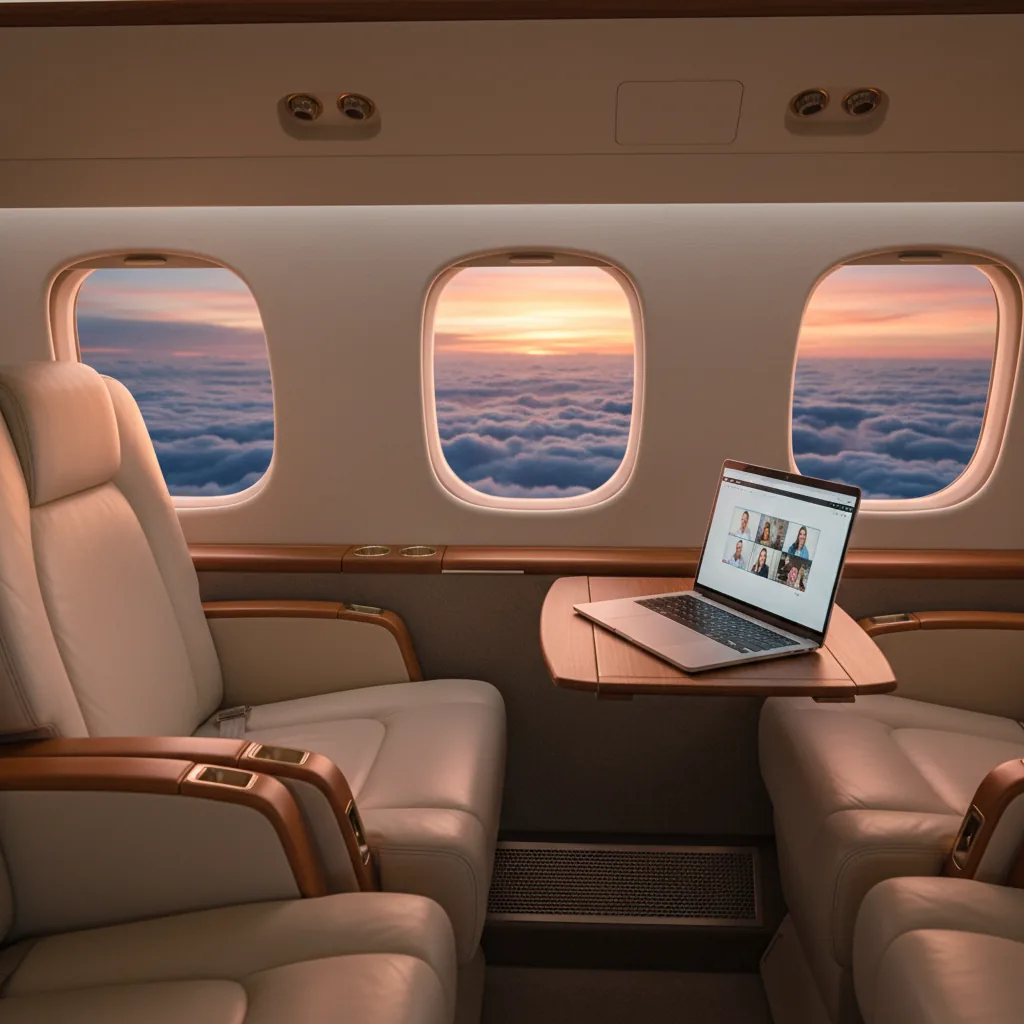
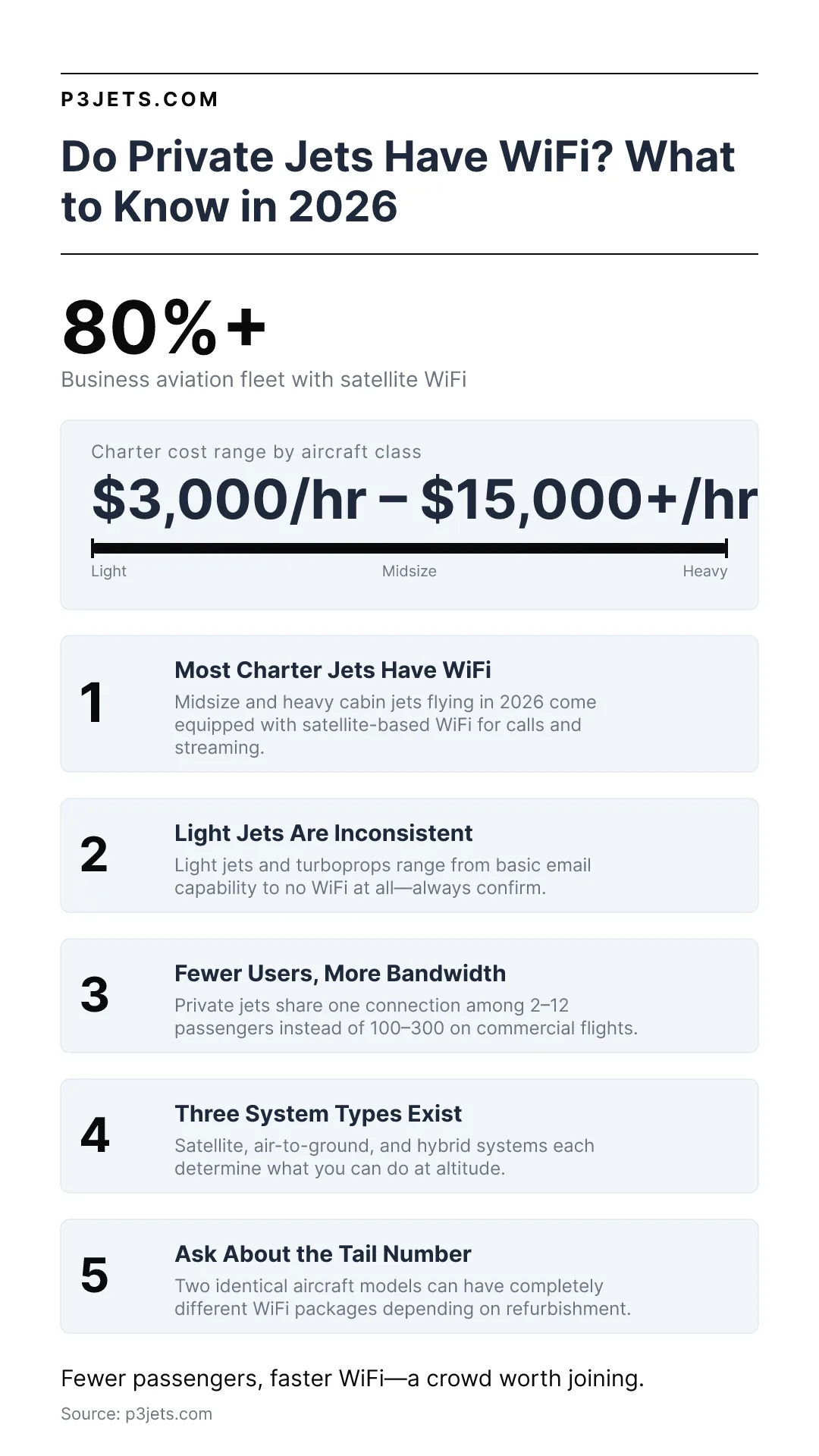
- Most midsize and heavy cabin private jets flying in 2026 carry satellite WiFi capable of supporting video calls, email and streaming.
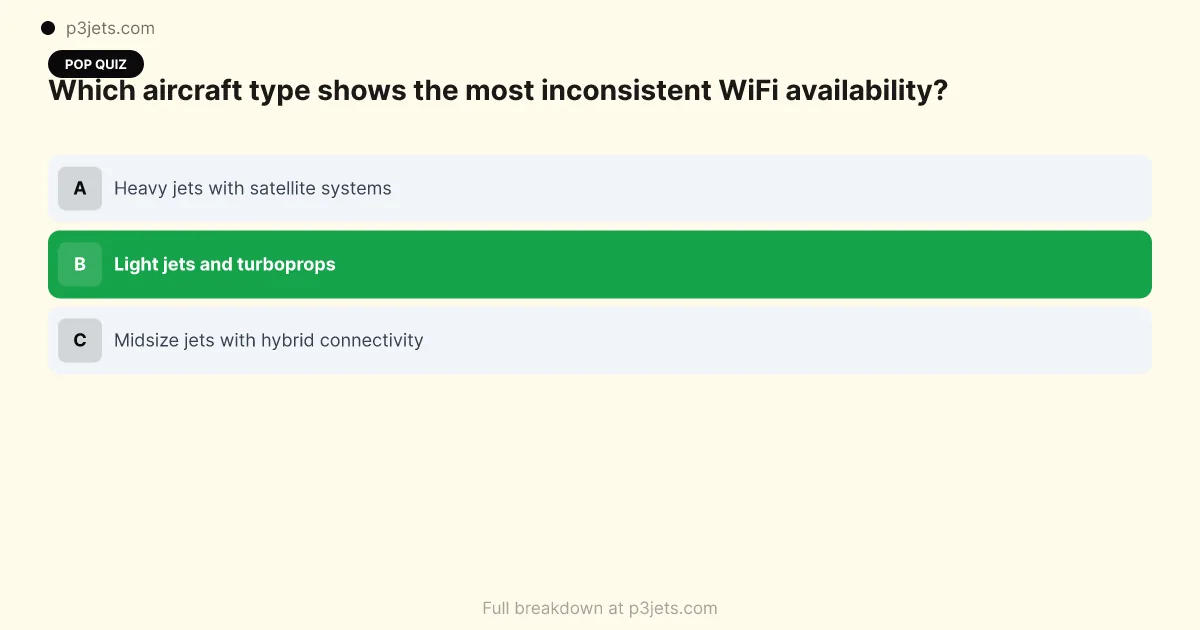
- Light jets and turboprops are the inconsistent cases, ranging from 25 Mbps satellite service to no connectivity at all.
- Connectivity follows the tail number rather than the aircraft type; two identical Challenger 350s can carry entirely different systems.
- Private jet WiFi shares bandwidth among 2 to 12 passengers instead of 100 to 300, which is why speeds per user are far higher than commercial.
- Ask three questions before signing: which system is installed, what speed tier it supports, and whether usage fees sit outside the quote.
WiFi stopped being a perk in private aviation somewhere around 2021 and became infrastructure. The trouble is that connectivity is installed per aircraft rather than per type, so the answer to whether your jet has usable internet depends on a tail number and a refurbishment date, not on a brochure. Here's how to find out before you're at 41,000 feet with a dead video call.
Do private jets have WiFi?
Most do. Heavy jets in charter service almost universally carry satellite WiFi delivering 15 to 100 Mbps, midsize jets are reliably equipped, and newer light jets increasingly are. Turboprops and older light jets are the gap, where you may find basic email service or nothing at all. Confirm per aircraft, never per category.
How does WiFi work on private jets?
Three system architectures serve the business aviation fleet, and the one installed decides what you can actually do at altitude. Satellite systems dominate, air-to-ground systems cover the continental United States only, and hybrids switch between the two based on route and coverage.
| System type | Typical speed | Coverage | Good for | Common providers |
|---|---|---|---|---|
| Ka-band satellite | 25 to 100 Mbps | Global, including oceanic | Video calls, streaming, large files | Viasat, Starlink Aviation |
| Ku-band satellite | 10 to 30 Mbps | Global with some gaps | Video calls, email, browsing | Gogo, Satcom Direct |
| Air-to-ground | 3 to 10 Mbps | Continental United States only | Email, browsing, messaging | Gogo Avance |
| Hybrid satellite and air-to-ground | 5 to 40 Mbps | Switches by route | Mixed domestic and international | Multiple integrators |
| L-band Swift Broadband | Under 1 Mbps | Global | Email and messaging only | Inmarsat |
| No system installed | None | None | Offline work | Common on turboprops |
Compact satellite terminals now weigh under 20 pounds, which is why light jets can carry service that was impractical five years ago. The National Business Aviation Association reports satellite connectivity across more than 80 percent of the North American and European business fleet.
If you're choosing between aircraft, our best jets for charter guide pairs connectivity with range and cabin size.
How does it compare with commercial airline WiFi?
The difference is arithmetic rather than technology. A commercial widebody splits one satellite connection among 180 or more passengers, so per-user speeds often fall below 5 Mbps. The same connection on a private jet serves 2 to 12 people, and nobody throttles your video calls.
| Feature | Private jet WiFi | Commercial airline WiFi | Practical effect |
|---|---|---|---|
| Users sharing the connection | 2 to 12 | 100 to 300 | Far more bandwidth per person |
| Typical speed per user | 10 to 50 plus Mbps | 1 to 5 Mbps | Video calls become viable |
| Video call reliability | High on midsize and heavy jets | Unreliable | Meetings can be scheduled inflight |
| Streaming | Supported on most equipped aircraft | Limited or blocked | No throttling on charter |
| Overwater coverage | Yes when satellite equipped | Varies by airline | Matters on international routes |
| Cost to passenger | Usually inside the charter quote | Free to $30 plus per flight | Confirm inclusion in writing |
Here's the honest caveat: on the right aircraft, private jet WiFi exceeds what you have at many hotels. On the wrong one it's worse than economy class. That's why the tail number matters.
What should you ask your broker about WiFi?
Ask three questions before you sign anything, and ask them about the specific aircraft rather than the type. The clients who care most about connectivity are often the ones who forget to confirm it, because they assume every private jet arrives with fast internet as standard equipment.
- Which WiFi system is installed on this exact tail number? Two identical Challenger 350s can differ entirely depending on refurbishment history.
- What speed tier does it support? The gap between video conferencing and email only is decided by the system, not the cabin size.
- Are there usage fees beyond the quote? Some operators include WiFi in the hourly rate, others charge $500 to $2,500 per segment.
- Does coverage hold on my route, particularly overwater or over remote terrain?
- How many devices can connect at once, if the whole group needs to work?
P3 Jets includes connectivity details in every all-in quote, so this is settled before you board rather than discovered after departure.
What does WiFi cost by aircraft class?
Most midsize and heavy jet operators fold WiFi into the hourly rate in 2026. Light jet operators are likelier to bill a flat session fee, and turboprop operators frequently have nothing to bill for. The fee, when it exists, is small relative to flight cost but belongs on the quote.
| Aircraft class | 2026 hourly rate | WiFi typically included? | Typical add-on fee | Realistic capability |
|---|---|---|---|---|
| Ultra long range | $13,000 to $19,000 | Yes | None | Streaming and video calls |
| Heavy jet | $9,500 to $13,500 | Yes | None | Streaming and video calls |
| Super midsize | $7,500 to $9,800 | Usually | $0 to $1,000 | Video calls, large files |
| Midsize jet | $6,200 to $8,000 | Usually | $0 to $1,500 | Video calls, browsing |
| Light jet | $4,800 to $6,500 | Sometimes | $500 to $2,500 | Email to video, varies widely |
| Turboprop | $3,900 to $5,200 | Rarely | Not offered on many aircraft | Email at best |
Full pricing context is in the charter cost guide and the cost per hour guide.
Empty leg flights are worth watching if you want full amenities at a lower price. They run 30 to 70 percent below standard charter pricing, and the aircraft keeps every system it carried on the paid leg, WiFi included.
Your next move
Before you sign a charter agreement, get the installed system, the speed tier and the fee structure in writing for the specific tail number you're flying. That single paragraph in your quote is the difference between a productive flight and three hours offline you hadn't planned for.
P3 Jets is a DOT Part 295 registered charter broker, and every flight is operated by an FAA Part 135 certificate holder or foreign equivalent. Advisors are available around the clock at (844) 767-8370, or request a quote on the charter page.
Sources and methodology
Pricing ranges reflect P3 Jets quote and booking records over a rolling twelve months. Regulatory and travel requirements are drawn from the primary sources below.