Key takeaways
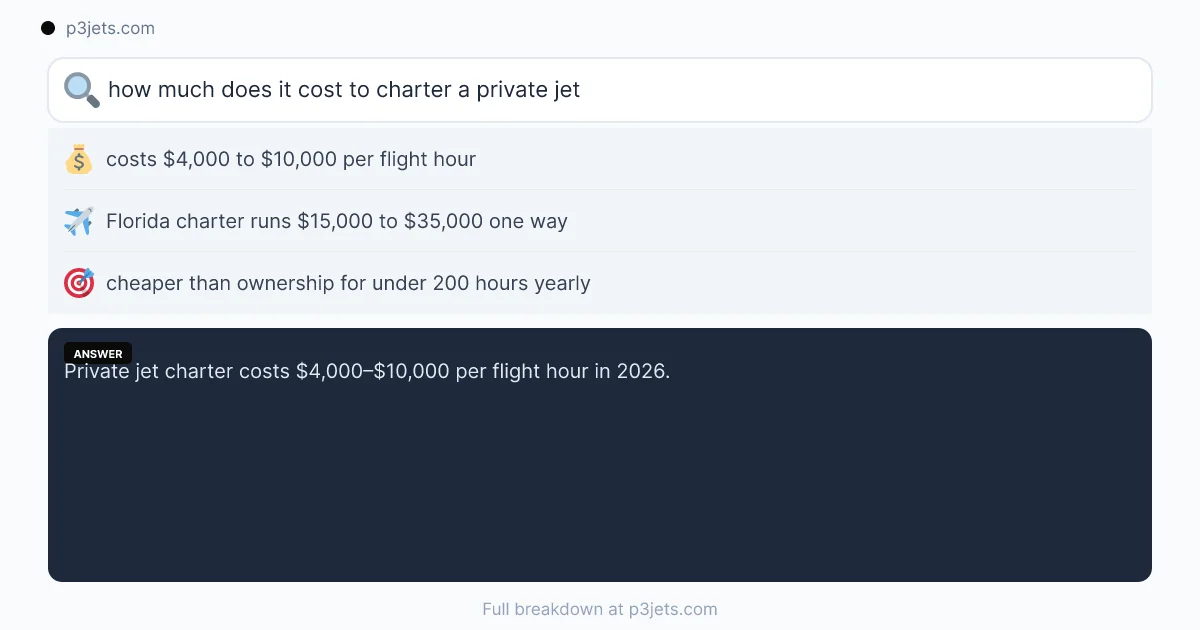
- Most private jet charters cost $4,000 to $10,000 per flight hour in 2026, depending on aircraft category, route distance and repositioning, before tax and fees.
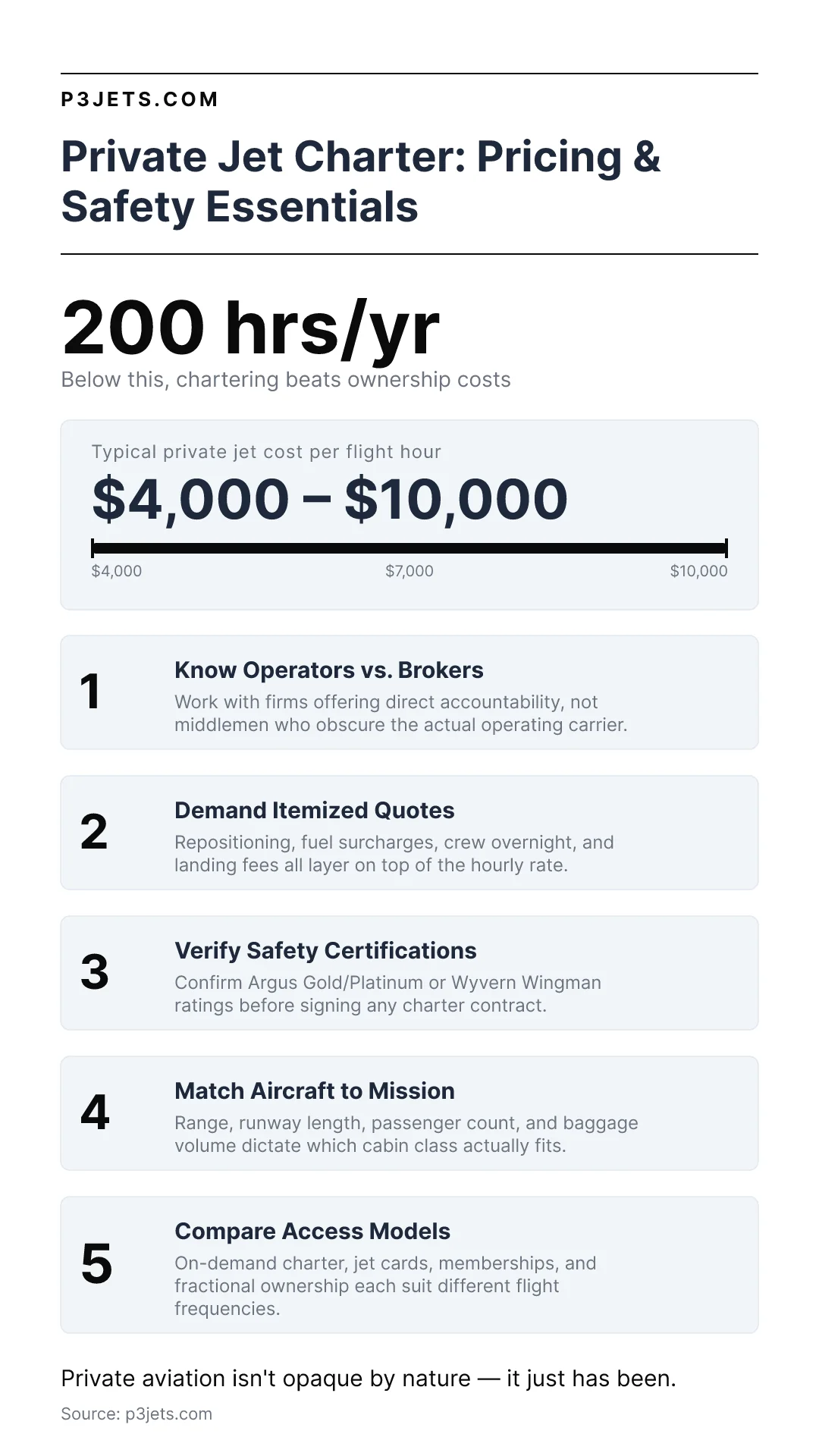
- The best charter firm discloses every fee before you sign and names the operator that actually flies your trip, whether you book direct or through a broker.
- Repositioning, overnight crew, landing fees, de-icing and the 7.5 percent federal excise tax sit on top of the hourly rate, so compare total trip cost rather than headline rates.
- ARGUS Gold, Gold+ or Platinum and Wyvern Wingman are the independent safety ratings to verify in writing before you sign a charter agreement.
- For most travelers flying fewer than 200 hours a year, chartering is far cheaper than owning once crew salaries, hangar, insurance, maintenance reserves and depreciation are counted.
A client called last year after receiving three wildly different quotes for the same route. One was all-in. One left out repositioning and overnight crew. A third wouldn't provide a breakdown at all.
That scenario plays out daily, and it points to the central problem with how most people approach a private jet charter for the first time: they compare prices without understanding what drives them, confuse brokers with operators, and skip safety vetting entirely. This guide strips away the opacity, covering operators and brokers, every cost line on a charter invoice, safety checks, aircraft selection and booking lead times.
Operators vs. Brokers: Choosing the Right Charter Firm
An operator holds the FAA Part 135 certificate and flies the aircraft; a broker sources the right operator for your trip and manages the booking. Either can be the right choice. The firm you choose should name the actual operating carrier on every quote, disclose every fee before you sign, and provide current safety ratings without hesitation.
Operators know their own fleet intimately but can only sell the aircraft they control. A good broker compares many operators and can find a better-positioned aircraft, which often lowers the price. The risk with any broker is opacity: if you can't learn who is flying the plane, walk away. Our broker vs. operator guide explains the legal and practical differences.
A private jet charter through P3 Jets means working with a team that prioritizes transparency, safety verification and direct accountability on every flight. We book full aircraft only, name the operator on every quote and work with ARGUS and Wyvern rated carriers, backed by our founder's 20+ years in aviation operations and brokerage.
Private Jet Charter Costs and Pricing Models
Most private jet charters cost $4,000 to $10,000 per flight hour in 2026, with turboprops at the low end and heavy jets at the top. Any provider quoting a single flat number without context is either oversimplifying or obscuring something. The hourly rate is only part of the picture, because the fees below are added to most trips.
| Fee type | Typical range | When it applies |
|---|---|---|
| Repositioning (ferry) | $2,000 to $8,000+ | Aircraft flies empty to your departure airport or back to base |
| Fuel surcharge | 5 to 15 percent of base | Fluctuates with jet fuel prices |
| Overnight crew | $500 to $1,500 per night | Crew stays overnight at your destination |
| Landing and handling fees | $100 to $1,000 | Varies by airport and FBO |
| Federal excise tax | 7.5 percent plus segment fees | U.S. domestic commercial air transportation |
| De-icing | $500 to $3,000 | Winter operations |
| Catering | $200 to $2,000+ | From snacks to full meal service |
The excise tax figure comes from the IRS rules on air transportation; the other ranges reflect current market quotes. A private jet charter to Florida from the Northeast typically runs $15,000 to $35,000 one way on a light or midsize jet, though repositioning and peak-day demand during winter season can push that figure higher. Our Northeast to Florida route guide covers that corridor in detail.
Is it worth it? Chartering pays off when time savings, schedule flexibility and privacy outweigh the hourly cost, particularly for groups of four or more, where per-person economics start to rival premium commercial fares. The charter vs. first class comparison runs the numbers.
Charter, Jet Card, Membership or Fractional: Which Access Model Fits?
Your annual flight hours decide the access model. On-demand charter suits most people flying under about 25 hours a year, jet cards fit roughly 25 to 100 hours, and fractional ownership becomes defensible past about 100 hours. Full ownership rarely makes financial sense below 200 hours a year once fixed costs are counted.
| Access model | Best for | Typical cost per hour | Key trade-off |
|---|---|---|---|
| On-demand charter | Under 25 hours a year | $4,000 to $10,000+ | Maximum flexibility; prices vary with the market |
| Jet card | 25 to 100 hours a year | Fixed rates, often $5,000 to $10,500 | Rate certainty; deposit paid upfront |
| Membership | 10 to 25 hours a year | Varies by program | Lower entry; annual fees and less predictability |
| Fractional ownership | About 100+ hours a year | Lower marginal rate | High upfront capital, monthly fees and depreciation |
| Full ownership | 200+ hours a year | Highest fixed cost | Total control; you carry crew, hangar and maintenance |
The jet card comparison guide breaks down how leading programs differ on rate structure and cancellation terms, and our charter vs. jet card vs. fractional guide maps each model to flight hours. The elephant in the room with all of them is transparency. Some providers bundle fees and call it all-inclusive; others quote low hourly rates and add surcharges later. Request a fully itemized quote and compare total trip cost.
Safety Vetting: How to Evaluate Charter Operators
Verify three things before you sign: the operator's FAA Part 135 certificate, a current third-party safety rating such as ARGUS Gold, Gold+ or Platinum or Wyvern Wingman, and adequate insurance. These audits go beyond the FAA baseline, and the gap between a well-run operator and a marginal one is wider than most clients realize.
Here's the uncomfortable truth: the information gap between operator and client is enormous. An operator knows its maintenance deferrals, pilot fatigue policies and audit history. The client knows none of it unless they ask, and assuming every certificated operator is equal is where risk lives. Use this checklist before committing:
- **Confirm the operating carrier.** If you book through a broker, verify the actual operator and its FAA certificate independently.
- **Request third-party audit status.** ARGUS and Wyvern both rate operators, and a reputable operator provides proof without hesitation.
- **Review the maintenance program.** Ask whether the aircraft follows a manufacturer-recommended inspection schedule.
- **Check operational control.** The pilot in command and director of operations should have final go or no-go authority, not the sales team.
- **Ask for the insurance certificate.** Liability limits should match the aircraft size and passenger count.
The paradox of safety vetting is that operators who welcome scrutiny are almost always the ones who pass it, while those who deflect are the ones to worry about most. Our operator vetting checklist and safety standards page go further.
Selecting the Right Aircraft for Your Trip
Choosing the right aircraft is less about prestige and more about physics: range, runway length, passenger count and baggage volume dictate which cabin class fits. Start with your group size and longest leg, then add baggage. A mismatch turns a smooth flight into a fuel stop, a cramped cabin or bags left behind.
| Group size | Category | Typical range | Approved hourly range |
|---|---|---|---|
| 1 to 6 | Turboprop | 1,000 to 1,500 nm | $3,200 to $4,500 |
| 1 to 6 | Light jet | 1,200 to 2,000 nm | $4,800 to $6,500 |
| 4 to 8 | Midsize jet | 1,800 to 2,600 nm | $6,200 to $8,000 |
| 6 to 9 | Super midsize jet | 2,800 to 3,500 nm | $7,500 to $9,800 |
| 9 to 14 | Heavy jet | 3,500 to 4,500+ nm | $9,500 to $13,500 |
Hourly figures are approved market ranges by category before tax and fees; a specific aircraft's quote will vary. See the private jet cost per hour guide for model-level detail. Oversized luggage such as golf clubs or skis often forces an upgrade regardless of passenger count, so disclose baggage upfront.
The cheapest route into a larger cabin is an empty leg, typically priced 30 to 70 percent below standard charter. The trade-off is that you don't control routing, timing or aircraft type, and the flight can change if the original trip does. Here's the catch: the cheapest option is also the one that demands the most flexibility. The empty leg guide covers the process.
Booking Logistics and Lead-Time Requirements
Most domestic charters can be arranged within a few days, but booking one to four weeks ahead gives you the best aircraft and pricing. Holiday corridors and peak winter weekends need the longest lead times, while shoulder months often allow last-minute bookings at standard rates. Pets, catering and international legs also need advance coordination.
| Season | Demand | Recommended lead time | Pricing impact |
|---|---|---|---|
| January to March | High on Florida, ski and Caribbean routes | 2 to 3 weeks | Premiums on peak weekends |
| April to June | Moderate, rising into Memorial Day | 1 to 2 weeks | Standard; holiday weekends higher |
| July to August | High on Northeast resort routes | 2 to 4 weeks | Peak surcharges around July 4th |
| September to October | Lower | 3 to 7 days | Often below peak rates |
| November to December | Holiday surge | 2 to 4 weeks, earlier for holidays | Premiums on holiday corridors |
Routes like the Northeast to Florida migration around Thanksgiving, or July 4th private jet charter demand to resort destinations, tighten weeks in advance; our peak day planning guide lists the dates to watch. Pets are welcome on many aircraft with advance notice, though operator pet fees may apply; the pet friendly charter guide outlines the rules.
Your Next Move
Define your mission first: passengers, baggage, route and schedule flexibility. Then request quotes from at least two providers, compare all-in costs line by line, and verify the operator's certificate and safety rating before signing anything. The difference between a good charter experience and a disappointing one almost always traces back to that initial homework.
Private aviation doesn't have to be opaque. It just has been. Request an itemized quote or call (844) 767-8370, and we'll name the operator, the aircraft and every fee before you commit.
Sources and methodology
Pricing ranges reflect P3 Jets quote and booking records over a rolling twelve months. Regulatory and travel requirements are drawn from the primary sources below.