All articlesProvider Reviews

    Best Private Jet Companies in 2026: A Criteria-Based Ranking for Charter, Cards, and Fractional

    The best private jet companies in 2026 are not the ones with the largest fleets. They are the ones that match the right aircraft to your mission at a price you understood before you signed.

    By P3 Jets Charter Advisory Desk•Last updated: September 2026• 12 min read

    Last reviewed September 11, 2026 by a P3 Jets charter advisor. Pricing ranges come from our own quote and booking records. See our editorial standards and AI disclosure.

    Ready to plan your next trip?

    Send us your itinerary and an advisor will respond with a quote and aircraft options.

    Speak to an Advisor
    Best Private Jet Companies in 2026: A Criteria-Based Ranking for Charter, Cards, and Fractional - P3 Jets private jet charter guide

    Key takeaways

    • The best private jet companies are not the ones with the largest fleets, they are the ones that match the right aircraft to your mission at a price you understood before signing.
    • Charter brokers, fleet operators, jet card providers and fractional programs serve different travel patterns; choosing the wrong model costs more than choosing the wrong company.
    • ARGUS Gold or above, Wyvern Wingman and IS-BAO Stage 3 are the most reliable third-party indicators of operator quality.
    • A two hour flight on a light jet typically costs $8,000 to $14,000 all in, while a midsize jet on the same route runs $14,000 to $22,000.
    • Judge a company on operator disclosure, all-in quoting and how it handles a change request rather than on marketing polish.

    Every private aviation company claims safety, service and value. The way to separate them is to stop reading marketing copy and start applying four tests: which business model they operate, what safety credential they require, whether their quote is all in, and what happens when your plans change. Those four answers tell you everything.
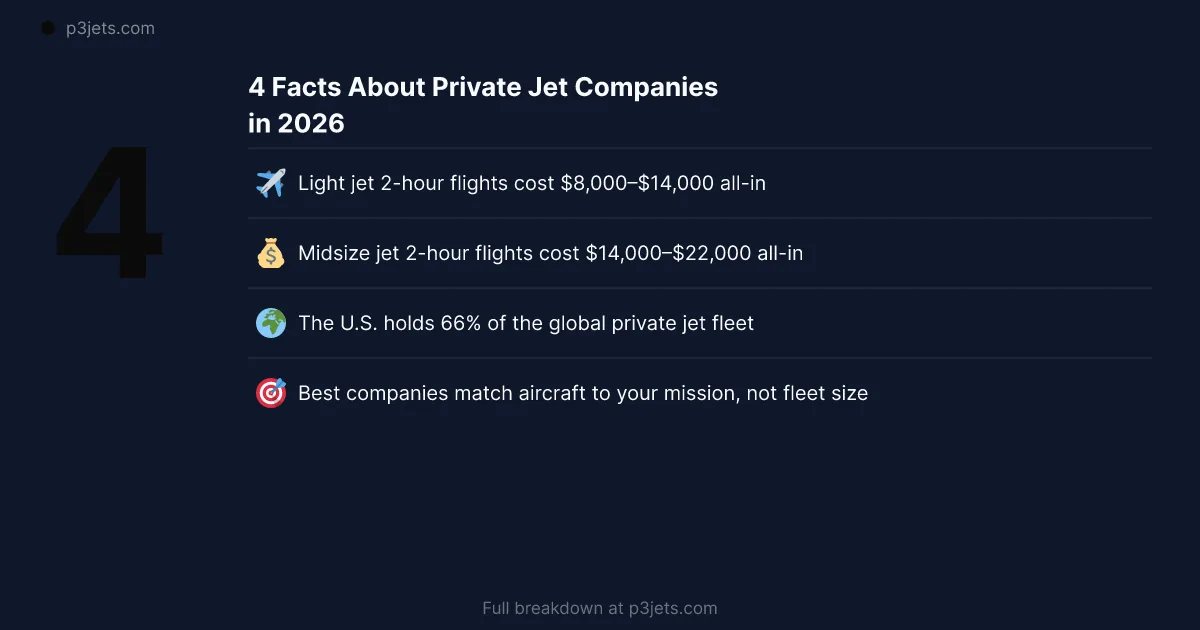
    Summary card listing four facts about private jet companies in 2026, including light jet and midsize jet two-hour costs
    The short version of how private jet companies compare in 2026.

    What separates the best private jet companies?

    Verified safety standards, all-in pricing and responsive human service rather than marketing spend. The strongest signal is whether a company names the certificated operator and tail number before you sign, because that single disclosure indicates how it treats everything else.

    P3 Jets operates as a charter broker and requires ARGUS Gold or equivalent standing for every operator in its network, so each quote stands on its own merits. Our operator vetting guide sets out the exact questions to ask any provider.
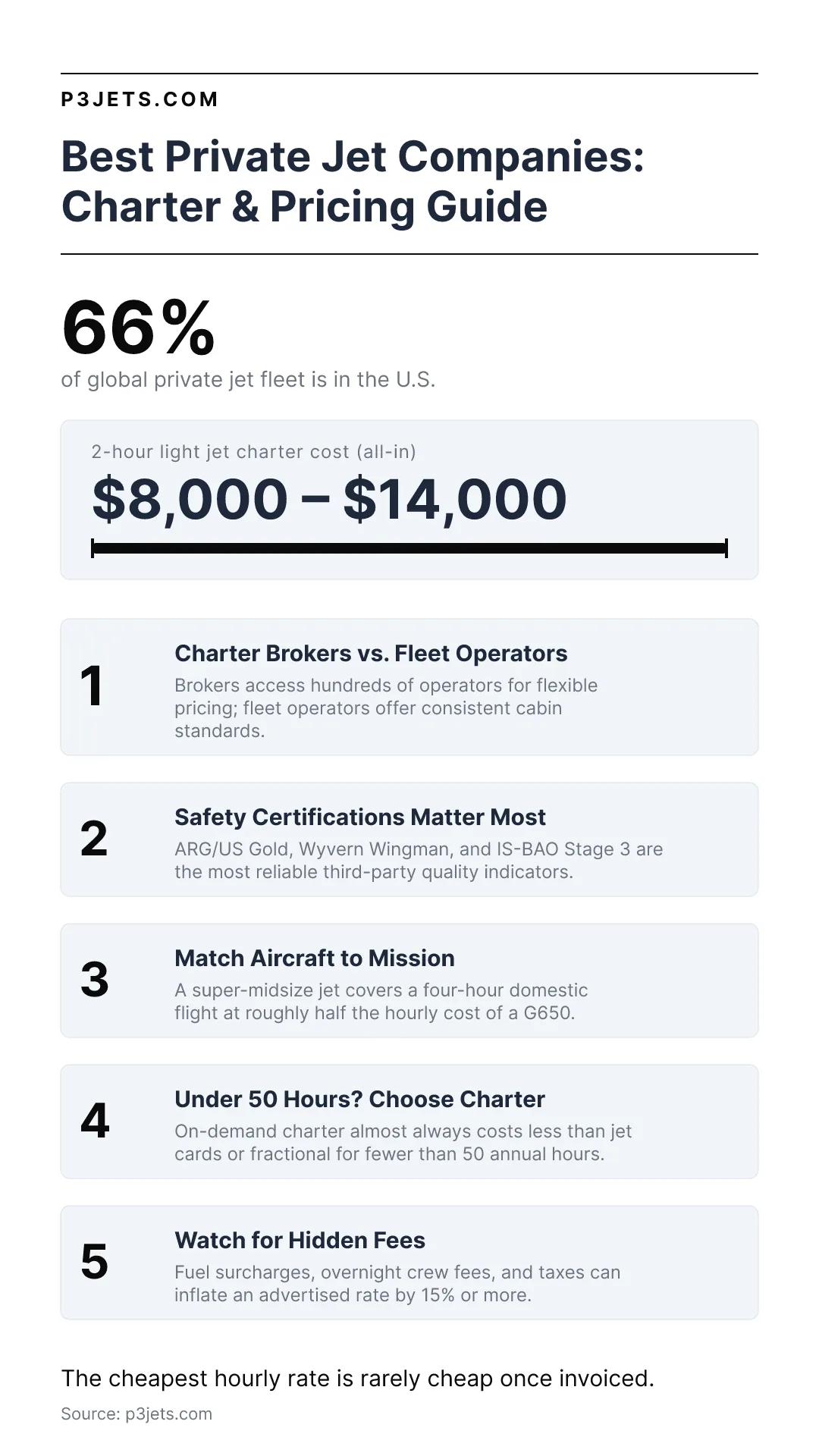
    Infographic on the best private jet companies showing 66 percent of the global fleet in the U.S. and five buying rules
    Five rules for judging a private jet company, plus the numbers behind them.

    Which business model fits your flying?

    On demand charter under about twenty five hours a year, a jet card between twenty five and a hundred and fifty hours, and fractional or ownership only above that with predictable utilization. Model choice matters more than company choice, because the wrong model costs more than the wrong brand.

    ModelAnnual hoursCapital committedAvailabilityBest for
    On demand charterUnder 25NoneQuoted per tripOccasional and variable trips
    Charter brokerAnyNoneWidest fleet accessTravelers wanting choice per trip
    Fleet operatorAnyNoneOwn fleet onlyConsistent cabin standards
    Jet card25 to 150$100,000 and up depositedGuaranteed with calloutRepeat, predictable flying
    Fractional share150 to 400Share purchase plus feesGuaranteedHeavy sustained use
    Full ownership400 plusAircraft purchaseTotal controlVery heavy use

    A broker sources from hundreds of FAA Part 135 operators, which gives access to more aircraft, routes and pricing than any single fleet can. A fleet operator offers cabin consistency instead. The full comparison is in our charter versus jet card versus fractional guide.

    What does a private jet actually cost in 2026?

    A two hour flight on a light jet typically costs $8,000 to $14,000 all in, and a midsize jet on the same route runs $14,000 to $22,000. Whole-trip cost, not the hourly rate, is the number to compare between companies, because repositioning and minimums vary.

    Aircraft classPassengersHourly rate2 hour flightTypical mission
    Turboprop6 to 8$2,500 to $4,000$6,000 to $9,000Short regional hops
    Light jet5 to 6$3,500 to $5,500$8,000 to $14,0001 to 3 hour trips
    Midsize jet7 to 8$5,000 to $7,000$14,000 to $22,000Coast to interior
    Super midsize8 to 9$6,500 to $9,500$16,000 to $24,000Transcontinental
    Heavy jet10 to 16$8,000 to $15,000$20,000 to $32,000Groups and long range
    Ultra long range12 to 16$12,000 to $20,000$28,000 to $45,000Intercontinental

    Ranges are planning figures rather than quotes. Two companies quoting the same aircraft can differ substantially once repositioning, daily minimums, federal excise tax and fuel surcharges are counted, which is why all-in quoting matters.

    Which safety credentials should you require?

    An FAA Part 135 certificate as the floor, then current ARGUS Gold or above, Wyvern Wingman or IS-BAO registration as the independent check. Ask for the specific level rather than a general claim of being rated, since ARGUS Gold and Platinum are not the same thing.

    • FAA Part 135 certificate held by the operator, verifiable in the FAA registry.
    • Current ARGUS rating, with the level stated.
    • Wyvern Wingman rather than merely Wyvern Registered where available.
    • IS-BAO stage level and registration date.
    • Two type rated pilots on every leg, with stated experience minimums.
    • Operator name and tail number disclosed before contract signature.

    Any company that hesitates on the last item has answered the question. Our full standard is published on the safety page.

    How do you compare quotes fairly?

    Insist on all-in numbers and read what is excluded. A quote that looks 15 percent cheaper often excludes federal excise tax, de-icing, catering, overnight crew costs or a repositioning leg, and the difference reappears on the final invoice rather than disappearing.

    Ask each company the same three questions: which operator and tail number, what is excluded from this figure, and what happens if I move the trip by a day. The answers rank companies more reliably than any published list.

    Where do brokers add value over fleet operators?

    In choice and in pricing pressure. A broker can put a light jet, a midsize and an empty leg option side by side for the same trip, while a fleet operator can only offer what it owns. Empty legs price 30 to 70 percent below standard charter pricing and are only visible with multi-operator access.

    The counterweight is consistency: a fleet operator delivers the same cabin every time. Travelers who value predictability above choice reasonably prefer that, and the honest answer is that both models are legitimate for different people. PorterJets LLC dba P3 Jets is a DOT Part 295 registered broker.

    Your next move

    Pick the model that matches your annual hours before you shortlist companies, then test your shortlist with the three questions above on a real trip. One quoting exercise reveals more about a company's practices than a month of comparing websites.

    P3 Jets quotes all in, names the operator and tail number before signature, and prices empty leg alternatives alongside standard charter. Call (844) 767-8370 or request a quote on the charter page.

    Sources and methodology

    Pricing ranges reflect P3 Jets quote and booking records over a rolling twelve months. Regulatory and travel requirements are drawn from the primary sources below.
    Frequently asked questions

    What are the best private jet companies in 2026?

    The best providers are not the ones with the largest fleets but the ones that match the right aircraft to your mission at a price you fully understood before signing. Judge candidates on four things: which business model they run, what safety credential they require of operators, whether their quote is genuinely all in, and how they handle a change request. A company that names the certificated operator and tail number before signature usually gets the rest right too.

    How much is a 2 hour flight on a private jet?

    A light jet typically costs $8,000 to $14,000 all in for a two hour flight with five to six passengers, and a midsize jet on the same route runs $14,000 to $22,000. Super midsize aircraft land around $16,000 to $24,000 and heavy jets $20,000 to $32,000. Compare whole-trip cost rather than hourly rates between companies, since repositioning, daily minimums, federal excise tax and fuel surcharges vary considerably from one quote to another. Ask for the all-in figure for your specific route rather than a published hourly rate, because that is the only number two companies can be compared on honestly.

    What is the difference between a charter broker and a fleet operator?

    A broker sources aircraft from hundreds of FAA Part 135 certificated operators, giving access to a wider range of jets, routes and pricing than any single fleet can offer, including empty leg opportunities that price 30 to 70 percent below standard charter. A fleet operator owns its aircraft directly, which delivers more consistent cabin standards trip to trip. Brokers offer flexibility and pricing pressure, operators offer predictability, and both models are legitimate for different travelers.

    Should I choose a jet card or on demand charter?

    On demand charter suits most travelers flying under about twenty five hours a year, because it commits no capital and lets the aircraft be matched to each trip. A jet card makes sense between roughly twenty five and a hundred and fifty hours where guaranteed availability and fixed hourly rates aid planning, though it requires a substantial deposit and carries peak day restrictions. Fly on demand for a year first, measure your actual hours and routes, then decide.

    What safety certifications should a private jet company require?

    An FAA Part 135 air carrier certificate is the floor, and it must be held by the operator rather than the broker. On top of that, look for current ARGUS Gold or above, Wyvern Wingman rather than merely Wyvern Registered, or IS-BAO registration with the stage level stated. Ask for the specific level rather than a general claim of being rated, since ARGUS Gold and Platinum represent different depths of audit and are not interchangeable in practice.

    How do I compare private jet quotes fairly?

    Insist on all-in figures and read the exclusions carefully. A quote that appears fifteen percent cheaper frequently omits federal excise tax, de-icing, catering, overnight crew costs or a repositioning leg, and that difference reappears on the final invoice rather than vanishing. Ask every company the same three questions: which operator and tail number, what is excluded from this number, and what happens if I move the trip by a day. The answers rank providers reliably.

    Is fractional ownership worth it?

    Only with sustained, predictable utilization above roughly a hundred and fifty hours a year. Fractional programs require a share purchase plus monthly management fees and occupied hourly rates, and the capital is illiquid with a residual value risk at exit. Below that threshold, a jet card or on demand charter almost always costs less on a total basis. The common error is committing capital before the flying pattern is actually established rather than after measuring it.

    Are empty leg flights worth pursuing?

    For flexible travelers, yes. Empty legs are repositioning flights sold at 30 to 70 percent below standard charter pricing, and they are only visible through providers with multi-operator access rather than a single fleet. The trade-off is that each one is a specific aircraft on a specific route and date, and it can move or cancel if the originating trip changes. Register your routes so an advisor can call you when a genuine match appears.

    Which country has the most private jets?

    The United States accounts for roughly two thirds of the global business aircraft fleet, which is why the majority of top-rated charter companies, jet card providers and fractional programs are headquartered in North America. That density is also why domestic charter pricing is comparatively competitive and why empty leg supply is far better in the United States than in most other markets, particularly on high volume corridors such as the Northeast to Florida route. It also means a United States based provider will usually have more aircraft options on your dates than an overseas equivalent quoting the same trip.

    How do the best companies handle changes and cancellations?

    Transparently and in writing, with the terms visible before you sign rather than after. On demand charter typically allows changes with defined notice windows and cancellation fees that escalate closer to departure, while jet cards publish their own change rules and peak day callout requirements. Ask specifically what happens if you move the trip by a day, because a provider's answer to that question reveals more about its service culture than any brochure. Get those terms in writing before you sign, and confirm who you call after hours when a departure needs to move at short notice.

    Is a bigger fleet better?

    Not by itself. Fleet size tells you about a company's capital position rather than about how well it will match an aircraft to your trip. What matters is access to the right aircraft on your dates, an enforced safety floor, all-in quoting and a human who answers the phone when plans change. A broker with no aircraft can deliver a better outcome than a large operator whose available tail is the wrong size for your group.

    Why choose P3 Jets?

    We quote all in, name the certificated operator and tail number before signature, and price empty leg alternatives alongside standard charter so you can see the options rather than take our word for the best one. Every operator holds an FAA Part 135 certificate with current ARGUS, Wyvern or IS-BAO standing and crew minimums above the regulatory floor. PorterJets LLC dba P3 Jets is a DOT Part 295 registered broker. Call (844) 767-8370. Our advisors also flag when an empty leg or a date shift would serve you better than the trip you originally asked us to price.

    Ready to plan your next trip?

    Send us your itinerary and an advisor will respond with a quote and aircraft options.

    Speak to an Advisor

    Request a Charter Quote

    Step 1 of 3

    Tell us about your trip - airports, dates, and passengers.

    Full aircraft charters only - we do not offer by-the-seat bookings.

    Jet charter typically starts between $4,000 and $10,000 per flight hour, depending on aircraft category.

    1
    ~30 min response Certified operators only No obligation
    5.0496 reviews

    Rated by clients on Google & other platforms

    Read